As someone who likes music from most periods after the Baroque (my dislike for that genre is best summed up by a friend's description of it as 'too tinkly'), and has had a long-standing interest in how it has been reproduced since its reproduction became possible in the first place, I have acquired a collection of mechanical and electrical equipment that would not be possible for my other great obsessions. I've always dreamt of having a 35mm projector in my living-room and having occasional screenings of My Fair Lady after dinner parties, but I'll save that for after I get myself a manor house of my own.
While packing up to come to to Oxford I was momentarily torn between my beloved Pathé gramophone and a selection of my favourite records, and my iPod; I eventually settled on the latter. I also left behind towering collections of CDs stacked on spindles (you can treat CDs this way because the reflective surface is either underneath the label or sandwiched somewhere in the middle). I don't have a cassette collection because I don't find the technology particularly interesting, and my musical coming of age occurred just after the tape recorder was the most uncool thing to have, and the age when music matters is usually the age when in matters to be cool.
Vinyl was a format that I came to terms with when I began my explorations into classical music. Square cardboard sleeves with faded pictures and crumpled paper liners were part of the house I left when I moved out. But ever since I got myself a proper turntable and discovered the wealth of good music to be had for a few pence I've never looked back (see earlier post, 'Vibrations in Time'). I regularly come home from Notting Hill or the Dickensian maze of dim, dusty aisles in the basement of Harold Moore Records in Great Marlborough Street heaving a load of records home. And at the risk of stating the obvious, records are eminently physical. They are heavy, they get scratched, they get lost; for no explicable reason, you end up loving one more than the other, like a ratty sweater that you'd rather wear than the latest fashion trend on those days when you feel the world is conspiring against you. So there are some perfectly good recordings that simply sit untouched, while a few records are cleaned more lovingly, wrapped in double layers of plastic sleeves, and played over and over. This is fetishism, at least as it is technically defined: the delightful physicality of a symphony embodied as a beloved object. Spin the record; turn me on.
One of the perks of having residency in the UK is being able to use the iTunes Music Store. It's actually now called the iTunes Store because in America they are now able to purchase and download television shows and movies off of it, but in the UK it's still music and music videos, so I will insist on the old name. Just as the invention of photography happened not with the daguerrotype but the negative and its capacity for infinite reproduction, the real shift between analogue and digital music came with the invention of the CD, which could be reproduced without degradation. The paranoia about piracy associated with MP3s and digital downloads is misplaced on more than one count: first of all, MP3s are just another way of writing down music 'digitally', AIFF being what is used on CDs; second, record labels have always been paranoid, as one will see by the number of LPs with warnings about the dire consequences of home recording printed on the sleeve. It's actually rather amusing to read these, and note that they have been worrying about the same thing for the last thirty years.
But although the labels and the RIAA (Recording Industry Association of America, also responsible for the equalisation standard that allowed a greater tonal range to be pressed onto the vinyl grooves) think they're worrying about the same thing, they're mistaken. There is a radical difference between analogue and digital: it's why music piracy should be the least of their concerns; it's also why vinyl sounds better than CDs and infinitely better than anything one downloads off the Internet, even from the iTunes Music Store. Digital is about numbers, expressed in terms of ones and zeroes; to transform music to numbers, one quantizes, or 'samples' the information coming off (usually) a mixing board; the higher the sample rate, the more accurately it conforms to the original. An analogue recording creates something, that can range from a wax cylinder to quarter-inch magnetic tape to a light show, that is analogous (hence the name) to the original. For mass production, an analogue 'master' is then transfered to another medium that will hold a copy that can be mass produced which is in turn analogous to the master. A digital distribution system, on the other hand, will take the 'master', which might be digital tape, a hard drive, or CD-R, and turn it into either CDs or the files you will see on iTunes, 128 kbps AAC files.
Digital will beat analogue most days of the week; but an analogue recording made using the best technology available today played on a very good turntable and cartridge is the best sound reproduction possible at present, because it hasn't been sliced up, turned into a number, and then decoded back to music. Classical music heightens the constrast between the two means of getting music into one's home because of its complexity: great tonal and dynamic range, and the layering of a wealth of information that, on analogue systems, can be problematic for a mediocre stylus (particularly problematic are the cannons on the 1812 Overture, which will always sound wimpier than a CD, and definitely pales in comparison to sitting beside the gunpowder at the Royal Albert Hall). But the 128 kbps file is problematic as well; it does not present a problem for pop music (this not being a disparagement of pop music, which can be occasionally scintillating), but if you think of alll the aural information that is being dispersed at the same time during a symphony, even if you get everything in the 41,000 times it is sampled in a second, all that information cannot be compressed into the file size. Another, equally important, problem with the iTunes Music Store is the amount of DSP occurs before it is finally encoded and put up on the site. There is a reason for this, which is that the sound engineers at iTunes create a sound that, not unsurprisingly, is optimised for use with the iPod, and therefore earpieces. All headphones, even the ones that are worth more than some of the heads that wear them like the legendary AKG 1000, have an inherent problem with spatiality. The sneaky solution to this has always been to introduce a certain amount of crossover from the left and right channels; no doubt Apple's sound engineers have even more complex algorithms these days to minimise the impression of the sound coming from the middle of one's head. Not surprisingly, the best-sounding tracks to download from the iTunes Music Store are those that were recorded exclusively by them. I like the simple acoustic version of Aimee Mann's songs from The Forgotten Arm that she recorded for them, perfect for the intimacy of in-ear listening; the album mix, which is also excellent but has very distinct channel separation, sounds very close to the live gig of her band that I caught at the Shepherd's Bush Empire. Yet another consideration is the dynamic range of classical music: if you put a classical CD on, you might notice that you have to turn up the volume; this is the issue of headroom, and what it allows is the fortissimo that happens later to rattle the window-panes the way it should.
There is even more to be said about the iTunes Music Store and the phenomenon of the iPod if we leave the technical aspects behind and look even cursorily at the social aspects of it, but this might be better left to actual sociologists. There is an incompatibility with listening to classical music at a low bitstream rate on earpieces; a technological solution will present itself in the foreseeable future; in the meantime, one can wait for returns at the Barbican. Classical music, like really good food, doesn't come out of cans.
Thursday


Saturday
The Importance of Motion
It was just one of those days when Oxford felt very far away from London. Almost everyone is resigned to using the services of The Oxford Tube, a coach service that runs 'every 10 minutes' ('at peak times'; sub-caption in microscopic font). The train service is for gamblers: you might get there in half an hour if you're lucky; if you aren't, you might find yourself being shunted to and fro endlessly in a Sartrean hell somewhere between Reading and Didcot Parkway. The Oxford Tube takes longer, but at least even if it's slow, it's predictably slow. Besides, it's less than half the price.
This was one of the days when slow was excruciating: at every stop before leaving Oxford there were fifteen people waiting to get on, all of them with luggage and wanting to pay with fifty pound notes. At a certain point, or, to be more precise, when the clock hit seven o' clock and we had just reached Hillingdon, I gave up on the idea that I would catch the play at all. We pulled in at the Marble Arch stop at twenty past, and I hopped into a taxi. As we passed Big Ben its hands read exactly 7.30. London taxi drivers know where everything is, or are supposed to, so you know they're lost when they say something like 'Um, er, the National is the theatre that's, er...' 'Directly in front of you with a sign projected onto its facade.'
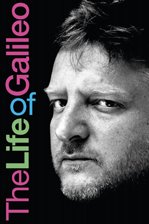
The play that I was impossibly trying to catch was The Life of Galileo, a play about which I knew nothing and had no expectations whatsoever. It was also part of the £10 sponsored season at the National, which was why I was fairly sanguine. If I missed the play completely, a stroll on the South Bank was an acceptable substitute; and I have, after all, lost more than £10 on poorly-judged purchases at a music store. But oh, what a waste it would have been if I had turned around and not walked the few extra steps to where an unexpectedly nice usher took pity on me and said he would sneak me in during a scene change in about three or four minutes. In all I missed about twelve minutes of a play that ran for three hours and ten minutes. And I'm actually considering going back to see all 190 minutes of it all over again, because every second of it was absolutely brilliant.
The costumes and sets were a melange of anachronisms, but the effect of this was to draw attention away from them, rather than toward: a kind of anti-operatic effect, to remove all sense of pageantry and period and focus attention on the text. Galileo's daughter, in flats and capris, could have strolled in off Oxford Street; on the revolve (the play is on the vast, well-equipped Olivier stage) she literally runs up against the cardinals in their medieval red and black. And in the middle of all this is Galileo himself, in a rumpled white linen shirt; he is not straddling these two worlds: he is what at the same time holds them together and yet, because he cannot help but do so, divides them by his words, ideas, and, not incidentally, his character. There are wonderful reviews of the play out there that I will not try to outdo, but I have to say that the two things the average educated person knows about Galileo were delivered brilliantly: the recantation, delivered offstage, with a time-shifted Simon Russell Beale sitting facing the audience, the map of the world on his face; and the coda 'e pur si muove' delivered in the final moments of the play visually, the very familiarity of the image delivering unto us, the audience, the universe as we know it.
It's a phrase that I have come to mutter, more in desperate hope than anything else, when the Oxford Tube is jammed on the ring road heading westward out of London.
Friday
Nice hair and no neuroses

Two of my favourite shows are wrapping up their final seasons (also known as being cancelled, an inhumanely casual sort of euphemism for ending the life of a series): Alias and The West Wing. Neither of them has appeared in DVD box set form yet, at least in the UK, but they are of course widely available on the Bitorrent underground network, and those of my friends who traffic in this sort of activity have given me mixed reviews of how each is brought to a close. I'll decide when the time comes whether I really want to see a pregnant Jennifer Garner (whose outfits have become less and less wearable since Season 3, incidentally) knot up JJ Abrams's promised 'ending with a bang'. The West Wing has been barely watchable for some time, despite a brief resurgence of intelligence in Season 5, but this will be more a valedictory parting of ways than anything else; I'd like to hang out with everyone for a final few hours, no matter how inane the script: one feels as though we have been through much together. But perhaps my lack of initiative to watch the final episodes are part of my inherent dislike of finishing anything: even with books I love, I have a tendency to stop just a few chapters shy of the end. The psychoanalysis involved isn't difficult: I have a natural fear of finishing anything, especially anything of my own; for after completion comes evaluation and, inevitably, judgement.
What I have been doing is starting on new series, and tonight I brought myself up to speed with the latest episodes of Doctor Who that aired while I was out of the country, and then found myself strangely absorbed with a workplace drama (never been my cup of tea) called Grey's Anatomy. It had all the elements of something I'd hate: for starters, an annoyingly pretty main character with great clothes, a tepidly good-looking love interest devoid of personality, with each episode built around a 'theme' about which Meredith Grey, the blonde surgeon whose makeup remains impeccable after a forty-eight hour shift, spouts predictable aphorisms. But it was recommended to me by someone whose taste has never led me wrong thus far, and indeed, I found myself shelving my past traumas of the genre from the likes of Ally McBeal and enjoying a sexy, well put together workplace drama. It's been almost a year since I left the workplace to get my second degree, and I suddenly remembered what a good day at work felt like: the feeling of doing something important and the satisfaction of a day's accomplishment; the pride of knowing that you're good at what you do; the subtle undercurrents of romance that spice up a day at the office.
The other rave I have about the series is the excellent music selection. I've always felt it was cheating, somehow, to get one's musical clues from television, rather than hanging out in smoky clubs to catch the newest band on the block; but life is short, I'm getting old, and I no longer read Vogue from cover to cover, nor do I grab the latest Guide Rouge and Gault-Millau hot off the press the way I used to. It caught my attention because I had been listening to Laura Michelle Kelly's 'Somewhere Only We Know' from her excellent The Storm Inside. It was another artist's version that was used, with excellent emotional timing, in the show, and I began to pay attention to the music; the highlight of Season One has to be Butterfly Boucher's 'Never Leave Your Heart Alone'.
But the final episode and predictable cliffhanger of Season One reminded me of the worst of the genre: an impassioned speech of pushbutton emotionalism, poorly written and badly delivered: it was like something out of Friends. Thank god that magnetic tape is not dead and that I have a friend who knows how to use his VCR (well, it's actually DVCPRO and it's his job), but thanks to him I can get up to date with the latest season of Spooks. I'm looking forward to some suitably depressing BBC fare until the next season of Grey's Anatomy comes out, with, no doubt, echoes of the spring collections in the copies of Marie Claire that I never actually had time to go through.
Thursday
Sound on wires

A friend and I had a nice, long Skype conversation the other day. It was also deep, meaningful, and emotional, but that's not germane to this post. The amazing fact of being able to have a phone-like conversation, across multiple time zones (or not: she could have been in the next room but pretending that she was in Kansas; or it could have been a metaphor) is still something that continues to amaze me. My previous experiences with Skype had not been auspicious; trying to use Skype on a laptop without a headset is a recipe for a disastrous conversation. Or three or four disastrous conversations, because you'll hear everything several times over.
This time, though, I was ready. I had a Shure large-diaphragm condenser microphone connected by a phase-inverting cable (aka XLR) to a mixer with a noise-reduction plug-in, in-ear monitors, and port forwarding. The only problem with this is that you're not quite sure whether to have a conversation or wait for the rest of the band to show up. Seriously, it feels very odd not to be clutching a handset. My senior tutor at Oxford has just gotten the hang of not holding the transducer to his ear and shouting into the telephone; he should get the hang of Skype in another thirty years' time. Meanwhile, conversations take on a certain performance aspect by the simple fact that one is one is standing before a microphone and pop-screen, and so, despite the fact that Skype is free, you feel the need to say something of Great Importance. Our next project is to attempt a three-way conversation with one of our male friends, who is generally into three-ways as a matter of course.
The other strange thing I've had to content with recently is paranoia that my phone is spying on me. 3G has many benefits; positive ones include the ability to check Gmail on the fly, but being able to locate you to tell you where the nearest cinema is can be somewhat disconcerting, and I'm sure can equally well be used to locate me for purposes other than to sell me Odeon tickets. It usually ticks away in silent mode (the official reason is that I find the ringing of a mobile phone intrusive, but I suspect it's actually a subconscious fear of unpopularity and I don't like to hear the absence of people calling me). Once in a while, though, it will suddenly flash into life for no discernible reason. Has someone hacked it and taken a picture of me typing away in my knickers? I've taken to wrapping it in swaddling cloth and burying it under the weight of the Complete Works of Byron. For someone who spends so much time with microphones and imaging gadgetry, being at home means being unseen and unheard, and the freedom, should I wish to do such a thing (but not that I would do such a thing, really) to stride naked across the room singing hit songs from the '90s.
Saturday
Better than a digital dowload

If there are two factors that can be said to have instigated the renaissance of my love affair with classical music, it is the radio and the phonograph: that is to say, my discovery of radio and the phonograph. One of the first things I did after moving into my dormitory quarters was to invest in a little clock radio; given that I have a problem controlling my irrepressible urge not to do things the normal way, it was inevitable that my little clock radio would be a DAB (Digital Audio Broadcasting) made by Tivoli Audio, known for those little, mono radios designed by the founder of Ruark in his dotage. I learned that you could connect a second speaker, a subwoofer, and even a CD player, and I brought home the little clock radio with one speaker with the vague idea that I would invest in the rest of the system later. I never did, partly because I eventually got a valve amplifier and standmount speakers, but mainly because it sounded so good on its own.
DAB was the next logical evolution for radio after FM. The difference between frequency modulation and amplitude modulation (known in the UK as medium wave), is a fundamental change in the way the signal is encoded: the metaphor usually used is that of a light blinking on a hilltop transmitting information; with MW (and shortwave, and most other forms of radio) the information is sent by the light flickering on and off. With FM, you have different colors of light, and the information is contained in the difference between the colors. DAB is though someone had put up a large neon billboard on the hilltop. Those who understand computers might prefer to think of it as a broadcast form of streaming audio (usually at somewhere between 160 to 192 kbps). It isn't absolutely perfect; there are times when the error rate goes up to the point that the signal deteriorates and I find myself switching over to FM (imagine a foggy night when you can't make out the billboard, but can still see the colored flashes of light). But in general the broadcast quality is impeccable, and you have to hand it to the BBC when it comes to sound engineering (and content).
Even better than BBC 3, though, is the UK's main classical music station, Classic FM. Their hegemony is so strong that they have their own record label, cable television channel, and music magazine as well. The programming, however, is top-notch, especially when you consider that this is a commercial radio station and not a state-sponsored one; classical music radio is not generally an easy sell in the contemporary world. Classic FM does (it would appear from the commercials) have a certain leaning in its listening demographic common to most classical music stations, and so one has to sit through contant ads related to erectile dysfunction, inheritance tax lawyers, and the like. But they are careful to make sure that they get a wide variety of phone-ins and emails, and in fact tend to bias those who aren't rich old men in carpet slippers looking out over their estate, favoring instead children, students, and the working class (either that, or these are the people who bother phoning in). There is a conscious aversion to 'greatest hits' and canonical performers; or you get one and not the other. Every so often they throw in something unexpected, like a movie theme, and on weekend evenings they play chill-out music under the rubric of a show called the Chiller Cabinet.
Even though I can now legally watch television, I only bother to tune in on Saturday evenings for you-know-Who. But the radio is a constant companion; it's so addictive that it has tended to get in the way of revision for examinations. 'Revision' is the British term for what I know as 'reviewing'; both are etymologically parallel in meaning 'to see again', my experience of revision is closer to the way I usually understand the word, as meaning a change or adjustment, i.e., 'so that's that the professor was talking about during the lecture that I hadn't read up for'. Come exam season the call-ins include lots of students asking for some Shostakovich to keep them company while revising. 'Good luck with your examinations, and here is the Fifth Symphony!' I myself am incapable of multitasking: this is a legacy of my age, I think; I grew up when 64MB of RAM was a lot, and I am incapable of having multiple applications running simultaneously, and the same is true of my brain. Kids these days, who can send text messages while surfing the net and having sex all at once, genuinely baffle me. Oh no, wait, that was me just a couple of years ago.
The use of the phonograph in this day and age as a source input seemed to be the domain of fussy old geezers obsessively balancing their tonearms; this is a misconception. It's the domain of fussy old geezers and me. As I mentioned in a previous post, there are some types of music that the phonograph does reproduce better than digital sources, and it's worth getting new pressings of some of this stuff. But for the most part I'm luxuriating in the wealth of cheap material out there, especially for classical music. There's a church down the road where you can pick through records in a bin and then drop a few coins into a collection box. (Oxford seems to be in the process of dumping its vinyl wholesale, and I'm only too happy to cart them back to my room.) Second-hand vinyl shops, meanwhile, need a strong tolerance for dust, a lot of spare time, and the patience to deal with snarky shopkeepers (these shops seem invariably to be manned by someone who will look over your selections with raised eyebrows and a sneer). Then you have to clean them; isopropyl alcohol is what I would normally use, but in Oxford you will find yourself directed down the road to the pub, which sells the only alcohol they are familiar with in these parts. I am debating whether to wipe down my vinyl with Guinness, or resort to something like lighter fluid.
But lo! Attention sneering shopkeepers everywhere, hearken to what I have found at the bins lately: Ashkenazy playing Beethoven's Appassionata; Horowitz performing at the Royal Albert Hall; Dvorak's cello concertos; Rachmaninoff performing his own Third Piano Concerto; and, for some reason, er, Susanne Vega. Oh, sorry, you can't listen to them, because I've got them now and you don't. Played though valves, they sound simply wonderful, and far too good to interrupt for revision.
The best clock radio in the world
Classic FM
Thursday
Vibrations in Time

Last night I came home and put on some music. Note that this sentence can mean different things to different people; in my case, it meant something very different last night than it did a week ago. I've been a great fan of the iPod since its inception, to the point that I find myself the curator of a museum of iPods, from the first generation to the latest. This dovetails well with the clutter of my room and my listening habits: when I buy CDs I import them onto my computer, and throw them onto the iPod in uncompressed format. The CDs soon burrow under the cushions of the sofa, and then disappear forerver; computer hard drives and computers come and go with the turnover frequency of relationships (it's been a toss-up the last couple of years); and over the years my music collection is now stored on five iPods (that I really should back up, now that I think about it).
But last night what I did was I turned on my trusty old amp, which was hooked up to the monitor speakers I use for sound editing, and while waiting for the tubes to warm up, sorted through a pile of records and decided to put on Joni Mitchell's Blue. I pulled the record from the dust sleeve, put it on the turntable, and carefully brushed off the dust before clamping it onto the platter. I unclipped the safety latch from the moving coil cartridge and lowered the stylus point onto the edge of the spinning record, and heard a few seconds of what must be one of my favorite sounds in the world (contenders would be that of a cork being pulled from a bottle, or the muffled roar of jet engines roaring into life for take-off). Although the engineering behind it is well-documented, I've never ceased to marvel at how a miniscule stylus being wiggled around can separate into two channels and go on to replicate an illusion of space, one that is populated by a warm, living voice, instruments in the background, or an entire orchestra. I mean, I know how it works, but I don't really understand it, the way you don't understand £60 million: it just ceases to be meaningful as money. (If I ever do come into possession of £60 million one of these days I'll report back and tell you if it becomes any more comprehensible.)
As someone who was in the creative industry just as it was "going digital", I wrestled with the existentialist problems of digital versus analogue in my spare time, but didn't have much time to ponder it in the workplace. This meant that we ended up working with hybrid systems, and at the moment being a purist either way is just either obstinacy or silliness. Film still rules, but not to use non-linear editing would be uniminagable for me now. Between the purist simplicity of my manual turntable and the tube amplifier is a solid-state phono stage to get some gain on the weak signal from the moving coil cartridge. It's a gorgeous frankenstein, I swear.
And the great thing about vinyl is that it's ridiculously cheap. Actually, there's also ridiculously expensive "audiophile" vinyl, and I do admit to owning Sarah McLachlan's Afterglow and Mirrorball on 200g remasters; but audiophiles tend to be nutballs in general. Apparently there are people out there (perhaps with £60 million) who buy these £20,000 speakers or the price of a small apartment for a length of wire. I've complained about the unhelpfulness of computer forums in the past (as opposed to the excellent industry forums for imaging or design), but audio forums seem to be populated by phallus-toting men with more money than sense, who sign off each message with a list of their equipment (yes, really).
I spent a pleasant afternoon in Notting Hill trawling the second-hand record shops, and made a pilgrimage to Harold Moore's classical haven, conveniently opposite Metro Imaging labs. Although I was rushing to catch a show (Noel Coward's Hay Fever, at the Haymarket Theatre Royal, starring Judi Dench doing an impersonation of Norma Desmond), I managed to snatch up some Julie London, a Deutche Grammophon recording of Herbert von Karajan's Dvorak Nine, some EMI recordings of Sir Malcolm Sargent, the Beatles (Parlophone), and Edie Brickell.
 Apart from the last, these were from the days when record labels actually meant something; well, they still do today, to recording artists, but in the industry that has consolidated down to the big four, it makes me treasure my Sinatra on Capitol and Piaf on Pathe that much more. (When I was looking for a pair of monitor speakers a year ago I nearly purchased, in a fit of loony nostalgia, a pair of huge floorstanders each as big as a wardrobe from Decca sound labs.) Listening to great vinyl is a bit of a religious experience, and I don't mean that just in the audiophile's sense that the sound was heavenly (it varies, really); I mean it in the sense that it's evocative of an era before DRM and rootkit installers.
 As a product of my generation, vinyl will never be the main medium of delivery for my music, though I must admit that I actually haven't bought a CD for ages. Incidentally, of all the vinyl I came home with today, only one of them really makes sense as a purchase, and that's the Beatles: they are, after all, not available for download on the iTunes Music Store.
Sunday
What you get for £126

If you want to know what it's like to have a brush with the mafia, just try being living in England for a bit at a residential address. At some point, a letter from an insitution known only as "TV Licensing" will shove a friendly note in your letter-box, informing you of the legalities of watching television in the UK. This will be followed by one that says roughly the same thing but in a less friendly tone, and is printed in red ink. Then comes the one that hints at patrols involving "sophisticated detection equipment", followed by the same wrapped around a dead fish, and so on, until, finally, an envelope arrives on which is written NOTICE HAS BEEN SERVED, and inside which is a picture of a relative holding a copy of yesterday's paper and a note informing you that a hit, I mean, a raid, will be carried out in the next 48 hours. At this point I capitulated and paid up, even though I don't own a television set and don't watch television. But the idea of being woken up by the blunt muzzle of an automatic being pressed against my temple with the rest of the squad rummaging through my lingerie drawer in search of a concealed television set was too much to bear.
The upshot of all this is that now that I've spent so much on my television license, I've decided I should watch television so that my £126 doesn't go to waste. Besides, I've been championing the form for the past few years but bypassing the medium; i.e., I think that some of the best writing, acting, and directing being done today is being done for television, but I've always watched it on DVD. This is partly because I've never had the patience to tune in at a particular time, can't stand commercials, and because I want Dolby 2.0 at the very least. Now that HD is coming to England, I might change my mind, but an HD box is probably the last thing I need now with examinations coming up.
So if ever I watch teleivion now it's on my computer, as a little window on the screen (the resolution of my monitor is higher than broadcast resolution, so resizing it looks horrible). What does one get for £126? Without a decoder box, fairly terrible stuff, the worst of it being reality television involving extremely unattractive people, mixed in with the occasional BBC gem. This is what got me started on BBC programming, which in recent times has moved away from the type of fare it used to produce, which could charitably be described as "soothing" (try watching their adaptation of Mervyn Peake's Gormenghast). The most noticeable example of this change in BBC style is the new Doctor Who, which now for a change the Americans are trying to download on Bittorrent. I'd previously dismissed it as hardcore sci-fi, which, like opera as a musical genre, the best of which I like but most of which bores me. But the writer of the new series, Russell T. Davies, was quoted as being a Buffy fan and wanting to reclaim the genre. So I watched.
Its lineage from Buffy isn't the female heroine; for that, only Alias does it for me so far (on this point I concur with Anne Billson's book on BtVS, though I disagree with most of it); it's about good writing: shifting in a moment from funny to frightening; operating on a scale both intimate and human, and Saving the World (which both Buffy and the Doctor do on a weekly basis). Unfortunately, Doctor Who is pretty new, so I couldn't go on a seven-season marathon the way I did with Buffy. (Incidentally, American seasons are around twenty-two episodes of forty minutes each; British seasons are ten episodes usually about an hour long, since there are no commercials, which also means that they don't follow the four-act structure of American teleivision.) The second season is now airing, with a new actor playing the Doctor with a new swagger; the new season definitely has an air of confidence about it, as well as a very obvious budget bump.
And since I found myself home on a Saturday night, and with a television license withering away, I decided to fire up my little digital receiver and tune in. When I turned the sound down at the end of the episode, I could hear the same music through the walls and realized that my next-door neighbor was watching it in his flat, as were people in homes and pubs all over Britain. So this is what it's like to watch television. So how much is that HD box again?
bbc.co.uk/doctorwho
How much do you enjoy television?
Saturday
The Royal Hunt for an Opinion
It's a terrible thing, I know, but I'm the sort of person who is easily swayed by reviews. In the past, I'd swoop into London for a week or so and take in plays like a junkie on a binge, evenings and matinees all; and the bible by which I swore would be the capsule review I found in that particular week's issue of Time Out. I admit that this has led to some particularly horrifying disasters, such as Jerry Springer: The Opera, to which I dragged my friends, kicking and screaming, on the basis of a positive review (it's even more horrible than the title might suggest). But in general Time Out reviews are reliable, which can actually turn into a problem: because they're usually so trustworthy, there's the danger of falling into lazy complacency and allowing them to form your opnions for you.
These days, now that I have the luxury of watching plays at my leisure, I actually miss out on more plays than when I would parachute sporadically into the country. Even worse, I now have the time to buy the paper every morning (okay, every afternoon), and sift through the contents at length with my breakfast cup of tea. This is what living out in the country does to you. One of these days I might actually take to ironing the paper before reading it. And it is thus that the authority of Time Out has been replaced by that of the Guardian, which I thought highly of but never really warmed to as a website, but is wonderful in its paper form: the nifty size! Those pert little sidebars! That neat modern typeface!
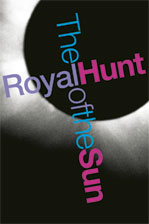
Alas, on more than one occasion I have not been able to stop myself from reading the review of a play before watching it, which was what happened with The Royal Hunt of the Sun. Actually, I can technically claim that I saw it before reading the review, but this was ten years ago and might even have been in translation. I couldn't even remember what the play was about; I do remember though that it was one of the plays that made me fall in love with the medium of theatre. The present production of The Royal Hunt of the Sun at the National Theatre is a resurrection of a 1964 play (yes, I cribbed that date from the Guardian review), with Trevor Nunn directing. Like an adulterer who decides he might as well get in a few extra boinks before telling his wife, I decided that I might as well go for broke, and read all the reviews. Then I went and saw the play.
I'm not going to trot out a statement about the play retaining its relevance and vsince 1964, since I wasn't around to see it in 1964; and relevant to what, anyhow? What I will say is that I probably have changed less than I might have thought in the span of ten years, and that what I loved about the play then is what I loved about it the other night: the almost operatic spectacle and pageantry that is theater in its oldest form, yet none of it gratuitous. I loved how a group of men can climb onto a bare wooden stage and with the aid of two swathes of cloth, hey presto, they are climbing the Andes. Most of all I loved how Peter Schaffer tightened the drama of civilizations and cultures in a complex relationship between two men.
So yes, I'm a weak person, and easily swayed by authoritative reviews, peer pressure, friends with strong opinions, etc. But once in a while I come across a piece that engages me so directly that I like or dislike it in the face of authoritative approval or disapproval. I'm not saying it's a perfect evening: yes, Peter Schaffer can be excessively talky; and I felt Trevor Nunn was gilding the lily with the strobe lighting at the end of the first act ("bet you didn't have this in 1964!"). I'd watched it with a friend that I had hijacked, who had in turn hijacked one of her friends, and because I'd flown back into the UK just the night before neither of them had any idea what we were all watching. Perhaps one of the best compliments that can be paid to Schaffer's writing is that it is the sort that polarizes people, or at least one tends to feel strongly about; one thing you will not leave the theatre wanting for is an opinion. I was watching the play with eyes as fresh as those of my friends sitting beside me, as though I hadn't seen it ten years ago, as though I hadn't gone and cheated and read those reviews.
But as for my little cultural quandary, I have the perfect solution: rather than desisting from my new daily ritual of disassembling the Guardian with my breakfast (I manage to do this despite not having a subscription by buying the newspaper in the evening and reading everything one day late), I'll try and see everything in previews. Then again, I could learn how to have an opinion of my own despite having read the reviews.
Thursday
V for Very Large
It was a night to remember, by any standards. On impulse I had decided to take abandon work for the afternoon, nay, the rest of the day; I wandered about the food halls of Selfridges and tried checking movie times for V for Vendetta, which I really wanted to watch in a theatre but which the local Odeon was no longer showing. But this was London; somewhere in the city, there must be some theatre still showing it in an upper attic of a multiplex, Screen 12 or something like that, a little room with a screen the size of a bathtowel. I negotiated the complex menus of WAP on my mobile phone, which spat out a surprising result: "BFI Imax 21.00", with a phone number. I called the number, and a voice mumbled, "Booking." "For V for Vendetta this evening?" "Well, there's really no need to book," sounding only slightly more awake, "you've got the theatre to yourself. Just turn up twenty minutes before nine."
I made my way to the Imax theatre on the South Bank by tube. I've decided that I enjoy the London Underground when I don't really have to get anywhere in a hurry, which was the case. I emerged at Waterloo Station and negotiated the draughty tunnels from which I emerged at the doorstep of the great glass cylinder that is the London Imax Cinema. As promised, I was almost alone in the theatre, which was just about the opposite of the tiny room at which I thought I might be able to catch it. This was almost worth seeing it after everyone else: a DMR (digital re-mastering) of the film on the 70mm Imax format. The picture was crystal clear, and so large that I sometimes had to swivel my head from side to side to take in a scene, but I was enjoying myself too much to want to move. Natalie Portman is someone worth seeing in a closeup shot fifty feet high, and though her acting stuttered on occasion, this was the actress I remembered from The Diary of Anne Frank (on Broadway), not the ham of the Star Wars epics. The final scene, the destruction of the Houses of Parliament to the soundtrack of the 1812 Overture, was delivered in appropriately thunderous surround sound.
But perhaps the eeriest thing about the movie was emerging from the theatre and deciding to take a stroll across the river to catch a bus rather than brave the tube past midnight on a Friday; and, lo, the Houses of Parliament appeared before me, respondent, symbolic. It was an odd experience to watch this film in London because, despite being a Hollywood production, they got so many things right about British culture, down to the sans serif typefaces of the signages to the irony that the tube station they filmed at was the abandoned Aldwych Station, right by the offices of the BBC. As I boarded the bus I was more aware than usual of the CCTV systems that would cover every step of my journey home.
Saturday
Social web browsing and other inquisitions
An amusing way to while away a wet and rainy afternoon is to cycle through blogs by clicking on the interests that you have listed for yourself and going through the blogs of those who share similar interests. Similarly, if you keep bookmarks on sites like del.icio.us as I do (though I got into the habit of doing it for practical reasons rather than sociability) then it becomes quite interesting to see who else has bookmarked a rather obscure site that you thought would be of interest to only to yourself. I look through their blogs or examine their profiles out of curiosity and the desire to discover other sites of interest, using these people as intermediaries, so to speak; just another way in which our society can be understood in terms of being a network of gargantuan proprotions. So in this manner I come across new sites of interest, a new web service to play with, new authors, new television shows. I will never contact these people and tell them that we share common bookmarks, why don't we be friends: nonetheless, for people with hermit-like tendencies such as myself, this is yet another reason to stay in my room and let the twenty-inch screen of the computer become my window to the world, and engage less in actual social interaction.
Because this, after all, is what friends do: they share music, books, experiences, ideas; and this comes before, and with the best of relationships, remains constant even as they become shoulders to cry on when a boyfriend leaves or take you home when you've embarrassed yourself at a party or take you to task when you've done three tabs of acid four nights in a row. And much as I value that, and think of my friends as family when my own is scattered across the globe and far away, I value the other aspect every bit as much: the quotidian exchange of information that no algorithm of recommendations will be able to replicate. The quirks and mannerisms, the eccentricities of personality, the unqiue way of speaking, the stories they tell over and over: these are, after all, what endears them to us, why we love them, the reason we say we know them. I have always felt that if I were to meet someone exactly like myself I would detest her immensely: the girl in the mirror is myself; but if she were to take on a life of her own and climb out from behind the looking-glass she would be someone I would want to throttle. There is a belief in popular mythology that if you wake up in the middle of the night and see someone who looks like yourself standing in the distance that it is an omen of death; perhaps there is a psychological underpinning to this bit of folklore.
We like our friends because they are different than us, but we love our friends for the extent to which they are of like minds to ourselves. Perhaps the decisive moment comes when in the course of time together and going through experiences together, that despite all you have in common that you hold a same or different morality. And the revelation of this morality, I have come to find as I grow older (but necessarily any more mature and certainly not nobler of thought or virtue) can be as much in the course of cataclysmic events as in quotidian companionship: in laughter; in its absence. When one moves beyond the family one is born into to "family" as defined by the people you surround yourself with, that one makes and chooses, the stakes become just a little bit higher. And this, I am firmly convinced, is a good thing.
Because this, after all, is what friends do: they share music, books, experiences, ideas; and this comes before, and with the best of relationships, remains constant even as they become shoulders to cry on when a boyfriend leaves or take you home when you've embarrassed yourself at a party or take you to task when you've done three tabs of acid four nights in a row. And much as I value that, and think of my friends as family when my own is scattered across the globe and far away, I value the other aspect every bit as much: the quotidian exchange of information that no algorithm of recommendations will be able to replicate. The quirks and mannerisms, the eccentricities of personality, the unqiue way of speaking, the stories they tell over and over: these are, after all, what endears them to us, why we love them, the reason we say we know them. I have always felt that if I were to meet someone exactly like myself I would detest her immensely: the girl in the mirror is myself; but if she were to take on a life of her own and climb out from behind the looking-glass she would be someone I would want to throttle. There is a belief in popular mythology that if you wake up in the middle of the night and see someone who looks like yourself standing in the distance that it is an omen of death; perhaps there is a psychological underpinning to this bit of folklore.
We like our friends because they are different than us, but we love our friends for the extent to which they are of like minds to ourselves. Perhaps the decisive moment comes when in the course of time together and going through experiences together, that despite all you have in common that you hold a same or different morality. And the revelation of this morality, I have come to find as I grow older (but necessarily any more mature and certainly not nobler of thought or virtue) can be as much in the course of cataclysmic events as in quotidian companionship: in laughter; in its absence. When one moves beyond the family one is born into to "family" as defined by the people you surround yourself with, that one makes and chooses, the stakes become just a little bit higher. And this, I am firmly convinced, is a good thing.
Honour Undriven
The Wyndhams Theatre used to be my favorite theatre in London, with its location right by the Leicester Square tube station, its intimate size, and the fact that several of my favorite plays, include "Copenhagen" and "Democracy" had successful runs there. Of late I've seen two duds in succession; well, one must qualify the the disparagement by pointing out that expectations were high: after all, if you have John Hurt and two other luminaries of the British stage in a play translated by Tom Stoppard ("Heroes"). Similarly, if you have Dama Diana Rigg and Natasha McElhone (pictured) and lots of exclamatory blurbs on tube posters, you gladly hand over £45 and rub your hands in gleeful anticipation.
"Honour" isn't rotten; like I said, it's a dud: it thumps to the ground like something unripened and inedible. It a terrible waste of a great premise, a good cast, and occasional patches of brilliant dialogue. But none of it comes together: the scenes are too short, and the transition between them awkward; the episodic quality is probably meant to make it fast-paced, but the net result is that scenes deliver the punch-line prematurely and ineffectually; without sufficient buildup, what could have been emotional body-blows glance off and hang limply in the darkness while the actors re-arrange themselves on the stage.
The play is about an intellectual couple, married for thirty-two years, whose marriage crumbles when Natasha McElhone's character (I usually buy a programme during the interval if I like the play; this one didn't have an interval, so I can't remember the names of the dramatis personae) invades their cosy intellectual domestic space in the guise of an interviewer having come to do a profile of the husband, flirting outrageously ("I know men want to fuck me"); the scenes of the interview alternate with scenes between him and his wife, during which they exchange smooth ironic repartee, evidently intended to portray a marriage between intellectual equals that has had all its corners and edges worn smooth with time. A logical addition which provides us an extra dimension from which to view the breakup is the a daughter who is roughly the same age as Natasha's character but not quite as clever or worldly, but from whom we learn nothing.
What ultimately lets the play down is its pacing. I can only suppose that, having managed to contract Dame Diana Rigg for the lead role (the man's wife, named Honor), they decided to squeeze as much emotion out of her as possible, so very early on in the play the smooth repartee turns into high-strung single-note emotionalism that simply could not be sustained for the rest of the uninterrupted hour or so after he decides to leave his wife for the willowy young interviewer. I was sitting in the stalls very close to the stage, where I usually like to sit, and despite the raw emotion gushing in floodwaves across the proverbial footlights, I found myself tuning out and thinking of where would be a good place to grab a bite afterwards. The ending, when it came, didn't so much leave me wanting more as made me leave wanting a play that did more. Watching this play is the opposite of seeing a masterpiece in a student production: it was an amateurish piece that a brilliant cast tried their best with. Though I have a sneaking suspicion that even Diana Rigg, while doing her scenes, was wondering if there was anything good on television later tonight.
Sunday
This Woolf Wrings
This evening I joined an old friend from Oxford and her sister for a preview performance of Who's Afraid of Virginia Woolf, recently transferred to London at the Apollo from its run on the other side of the Atlantic. By the grace of a patchy education, I had somehow managed to avoid having had to read the Albee playtext in high school or college and interpret it for literary symbolism; what did surprise me was that my friend and her sister, neither of whom are exactly intellectual slouches, had also escaped similar fates; as well as the equal or worse one, that of having had to watch an amateur performance of it.
Since the play is more or less established as canon, I don't expect to see any of the reviews in the weekend papers to have any comments on Albee's work as a piece of theatre (it was written and first produced in 1962). They'll probably focus on Kathleen Turner's (of Jewel of the Nile fame, as well as the somewhat more thematically related War of the Roses) and Bill Irwin's performances, and manage perhaps to cram in a few snippy remarks about how London theatre is being overrun by America (which I'd agree with, though not being British this fact is of interest but not frustration for me).
But the upshot of this mysterious gap in our literary education was that we entered the Apollo with no expectations; it could have been the latest Patrick Marber. And since Kathleen Turner was unrecognizable in her new blimp-like incarnation, we didn't feel we were watching a film star doing a career-saving stage turn. We went in fresh; and it was a fresh play that was delivered to us.
The fact that the claustrophobic one-room set, that doesn't change over the course of three acts that take place in "real-time" (it supposedly begins around two in the morning, and ends as dawn breaks), was contemporary to the original time setting of the play (phonograph records instead of CDs), was for the most part incidental and quickly forgotten. (I am glad though that no attempt was made to change the setting to the look of the present-day; that would just have been tiresome.) Quick summary of the performances: flawless, empassioned; absolutely intense. But because we did not know how the play would turn out or what it was thematically "about", we were watching it as theatre, without the emotional detachment of, say, the umpteenth staging of Hamlet. The violence of the language, as well as the physical violence, were perhaps not as shocking to us as it would have been to an audience in the early sixties, but the emotional impact of the George's smashing a bottle and his attempt to throttle his wife were unmitigated and unexpected. And as the play built itself up to its inevitable climax, we were squirming in our seats; the final fifteen minutes left N in tears (okay, and I as well); and the last few lines of the play had our skin crawling.
We wandered around the West End in a shell-shocked state for some time, feeling as though we had been put through an emotional wringer. I can't imagine how the actors go through this every night; perhaps they're such pros that after the curtain goes down they all traipse off to the pub nonplussed, but we felt we were in dire need of a medicinal amount of alcohol, and quickly downed a bottle of Argentinian red. (Yes, despite my recent mishap; but that was a particularly malevolent Gewurztraminer and was before dinner...don't trust the German winemakers, my grandfather used to say during the war...)
I did some rather belated homework about the play and its supposed intentions, and received more than a mild surprise. This is definitely a production that benefits from one's *not* having read the lecture notes. If you have the blessing of ignorance, as we did, get yourself to Shaftesbury Avenue and watch it as a piece of theatre. The emotional beating is a sadomasochistic treat, and the intellectual rewards are an incidental counterpoint.
Tuesday
Notes from Oxford
Music was the theme of the weeks past; it's getting hard to keep track of time in terms of calendar dates, as everything is now secondary to the timeline of the Michaelmas Term. I'm writing this at the start of Week Six, which I'm told is a good thing: not writing so much as being alive (the act of doing the former generally a sign of the latter); it is Week Five which is the killer. And somehow, like most Oxford cliches, it turned out to be true. By the end of the week I was a nervous wreck, with bloodshot eyes and barely paying any attention to personal appearances except to vaguely color-coordinate the sort of voluminous fluffy sweater that the British specialize in, under which you could have layers of thermal underwear, an explosive and detonator, or be completely naked and just rather tubby.
One advantage to Oxford's concert scene is its intimacy, which translates not just to being able to sneeze at the back of the conductor's head, but to the fact that everything is cheaper, and it's somehow less of a giant commitment to go and attend whatever's playing at the Holywell Music Room or evensong at Christ Church. The main problem actually is keeping track of all these; unlike London, there's no Time Out to consolidate all the information as to what's going on where and give a snippy little review for recurring productions. Quite logically, a good place to look for notices is the Blackwell Music Shop on Broad Street; one of my favorite things to do is actually to stock up on propaganda material (flyers, brochures, notices, lecture lists, etc.) and then settle in at a cafe and go through them at leisure. I can do this more than once a week if I'm bored, which is probably not good for the environment because I leave them all in a heap on the cafe table; but it no doubt gives the organizers of the Oxford Philharmonic and the like a feeling of gratification to see all of their flyers gone and in need of replenishing.
The other week I caught Stephen Hough, whose recording of Rachmaninoff won an Editor's Choice award from Gramophone Magazine, in a recital at the Jacqueline du Pré building at St Hilda's College. The venue was the sort of very small and well-lit space where if you cough everyone within a five meter radius turns around and gives you a long, expressionless stare; if you attempt to alleviate the cough by fishing for and unwrapping a lozenge wrapped in cellophane deep in a bag with a zipper and velcro pockets, even people from the upper gallery will glare at you. I'm usually less concerned about who's playing as opposed to what's being played, and I was a little disappointed to find that the programme was mostly Mozart: but Stephen Hough was indeed amazing. The Guardian, I believe, said that his was the "most perfect piano playing imaginable", or something to that effect; and while I would hesitate to say that (if only because I am less certain about the actual extent of my imagination) it really was brilliant, passionate, and apparently effortless. He didn't hitch up his pants and wiggle his shoulders and take a deep breath before hitting the first note the way most pianists do; he'd simply leap up onto the stage, sit down, and begin playing without a moment's hesitation, as though the music had been burning inside him and simply leapt into flame and up and out through his fingertips and into life and motion and sound and the most wonderful music that held the little roomful of people enthralled.
A slightly more elaborate affair was the Oxford City Orchestra at the Sheldonian; the concert, last Friday evening, had as its highlights Dvorak's Symphony No 8 and Rachmaninoff's Piano Concerto No 2. Rach 2 is one of my favorite pieces of music (as it is for many people), and I was at the same time eager to hear to hear it live and anxious not to be disappointed by limp piano playing or one of those conductors who pace it at a tempo as though he had forgotten to top up the parking meter. The twenty-four year old pianist who took centre-stage that night seemed a very happy chap, in both senses of the world; one of my companions theorized that it was this gay disposition that might have accounted for the somewhat florid interpretation. We agreed, though, that florid was better than austere; and my other friend, who had always shied away from Rachmaninoff having held the impression that his music was somewhat "dark" (which it can be), was pleasantly surprised. What did come as a pleasant surprise to me, from a technical standpoint, was that the acoustics were excellent, for which credit is due to the fact that the Sheldonian's roof is about to collapse. The vaunted (though not vaulted) ceiling of the theatre has been providing an added element of excitement to the university's functions by threatening to come crashing down, and is now swathed in swaddling-cloth; or perhaps Christopher Wren in 1664 got right what the modern engineers of the Opera Bastille couldn't do in terms of acoustics. Of course, there's no heating; the wooden benches are uncomfortable; and sitting in the upper galleries you feel that if you stand up too suddenly you might find yourself catapulting straight into the middle of the strings section of the orchestra. It was, in fact, so cold that the moment the applause died down we stampeded out as though there were a fire drill and took refuge in the warm confines of the Café Rouge.
www.stephenhough.com
Sunday
Of Latin Rites and Times New Roman
It's been over a week since our matriculation at the Sheldonian Theatre in the center of Oxford. Historically, the center of Oxford has been at Carfax, and this is still what would seem to be the central crossroads of the contemporary city; the university, however, has its noumenal center in the cluster of buildings that include the Radcliffe Camera, the Sheldonian Theatre (where degrees are conferred as well), and of course the Bodleian Library. The last-named is probably the closest one can get to a symbolic "heart" of the university (it's certainly not the fortress-like buildings of the University Offices in Wellington Square); the library card for the Bodleian also doubles as one's university ID. The Bodleian is an uplifting sight with yellow light pouring from behind the large window panes at dusk under the spires, and it's also a cosy idea to know that every book published in the United Kingdom is sitting somewhere there. This cosiness of the idea doesn't necessarily translate into practical terms, though: the Bodleian is far from being one of those libraries where you can spend countless hours wandering amidst shelves of books (it's not Barnes and Noble, after all): upon entering what you find are rows of computers running the arcane Telnet program, which the library still uses to search for books; this has neither the charm of a card catalog or the convenience of modern computer interfaces. The book, when you do find it, is likely to be "withdrawn", which is the Bod's equivalent of a museum's piece being in storage rather than on display. You fill out a request for the book, and make an appointment to read it in one of the reading-rooms. The reading-rooms are admittedly quite nice (I'm partial to the Upper Camera), but I'm an impatient person; I'll make an appointment to see my dentist, say, but to schedule to consult a book is somewhat laborious. Nor is the status of the Bodleian as a "deposit library" (by law, every book, journal, newspaper, magazine, etc., published must send them a copy) quite as watertight as they would like one to believe: these days, "publishing" can take many forms and its definition is becoming quite fluid, so people from across the disciplines have been commenting on how the Bodleian has been missing out on many key documents, even those which are in print. Let's see how they deal with the new publishing industry being created by the likes of lulu.com. Despite these criticisms I can never cross Radcliffe Square without thinking of the miles of books lying in the subterranean tunnels, ready to be conveyed the great sprawl of the Bodleian through the network of pneumatic pipes.
The University of Oxford does seem to be highly modernised, with every lecture I've attended so far being accompanied by a Power Point presentation as de rigueur; but one would think that a university of this calibre would also have cutting-edge IT technology. What I've seen so far seems to be the hegemony of Microsoft and its tell-tale harbinger and fingerprint, the ominprescence of Times New Roman. I am still reeling from the amount of Times New Roman I am subjected to on a daily basis; does anyone not think of varying the typeface at some point? I've never been a great fan of sans serif typefaces but coming home to my beloved Mac I am tempted to obliterate all the Times-related font sets from my computer's Font Book to salve my battered sensibilities. I suppose 800 years of history might be dragging the University down a bit, but if it pedalled a little harder, perhaps it could get beyond Windows 2000.
So, then. The verb "to matriculate" comes from the Latin "matricula", which means "stand around freezing your ass off in ridiculous costume on a drizzly Saturday morning". Oxford is one of the last universities to actually keep the tradition of the ceremony, which is to physically present oneself before the (in our case, Vice-Chancellor as representative of the) university, who was supposed to take down one's name in a notebook of sorts and thus recognize one as a member of the university. So in full battle gear (black gowns flapping in the wind, tassels a-twirling) we all filled the Sheldonian to the rafters for the ceremony, which lasted all of about seven minutes (including the pipe organ fanfare). The Sheldonian isn't a very large theatre, and there are thirty-six colleges, so everyone is hustled away quickly for the next batch to enter. But the real induction into Oxford, in my opinion, is the moment when you learn how to ride your bicycle while carrying a stack of books and balancing an umbrella in the rain.
The Bodleian Library
www.lulu.com
The University of Oxford does seem to be highly modernised, with every lecture I've attended so far being accompanied by a Power Point presentation as de rigueur; but one would think that a university of this calibre would also have cutting-edge IT technology. What I've seen so far seems to be the hegemony of Microsoft and its tell-tale harbinger and fingerprint, the ominprescence of Times New Roman. I am still reeling from the amount of Times New Roman I am subjected to on a daily basis; does anyone not think of varying the typeface at some point? I've never been a great fan of sans serif typefaces but coming home to my beloved Mac I am tempted to obliterate all the Times-related font sets from my computer's Font Book to salve my battered sensibilities. I suppose 800 years of history might be dragging the University down a bit, but if it pedalled a little harder, perhaps it could get beyond Windows 2000.
So, then. The verb "to matriculate" comes from the Latin "matricula", which means "stand around freezing your ass off in ridiculous costume on a drizzly Saturday morning". Oxford is one of the last universities to actually keep the tradition of the ceremony, which is to physically present oneself before the (in our case, Vice-Chancellor as representative of the) university, who was supposed to take down one's name in a notebook of sorts and thus recognize one as a member of the university. So in full battle gear (black gowns flapping in the wind, tassels a-twirling) we all filled the Sheldonian to the rafters for the ceremony, which lasted all of about seven minutes (including the pipe organ fanfare). The Sheldonian isn't a very large theatre, and there are thirty-six colleges, so everyone is hustled away quickly for the next batch to enter. But the real induction into Oxford, in my opinion, is the moment when you learn how to ride your bicycle while carrying a stack of books and balancing an umbrella in the rain.
The Bodleian Library
www.lulu.com
Saturday
Serenity, or Firefly writ larg(ish)
"Serenity" opened in the UK this weekend. Despite the good press the movie has been receiving all around, especially among British critics, I wasn't quite sure what to expect when I walked into the Odeon screening room in Oxford (where the screen is about the size of a large television set). I've always had great admiration for Joss Whedon (as evidenced by my unabashed admiration for the Buffy series, supra) but even on Buffy and especially on Angel he has always been uneven as well as unpredictable, and I was imagining the myriad ways in which he could fail to deliver.
But I needn't have worried: "Serenity", whether you've seen the "Firefly" episodes on DVD or at a newcomer to that universe, does not fail to deliver; not only is it coherent as a movie, but it manages to pick up roughly where the series left off, which means that for a fan it doesn't too much time on what we already know yet manages to introduce the premises of the futuristic setting and the characters in a few deft strokes. What is missing, of course, is the cosy familiarity one develops with the characters which is perhaps the biggest advantage of television over feature films: one comes to think of the "Friends" cast as one's friends; the detectives on "CSI" as one's collleagues at the workplace; "The West Wing" is at once a workplace drama and a family drama, with the president as a father figure presiding over a house. And (returning to "Serenity") anyone with any familiarity with Joss Whedon at all will know that he never has "clean" victories but that there always is a price, so I wouldn't count it as a spoiler to say that I knew even as the movie began that not all of them would make it; but I nevertheless lurched in my seat when it happened.
The other reviews I've been reading have focused a lot on the transition to "the big screen", but because of the venue where I happened to see it, four feet away from a small screen, UK projection dimensions (there's a difference in aspect ratio, i.e., a strip lopped off the top and bottom) in a theatre without DTS nor Dolby decoding (rather like the Mac, which uses its own mixdown even if you play a Dolby disc on it), it felt like a good, long episode: a season-ender, say. So is it the new Star Trek or even the new Star Wars? No, no. But I think it's fair to say that it might be the new Joss Whedon, which also does less disservice to all concerned.
But I needn't have worried: "Serenity", whether you've seen the "Firefly" episodes on DVD or at a newcomer to that universe, does not fail to deliver; not only is it coherent as a movie, but it manages to pick up roughly where the series left off, which means that for a fan it doesn't too much time on what we already know yet manages to introduce the premises of the futuristic setting and the characters in a few deft strokes. What is missing, of course, is the cosy familiarity one develops with the characters which is perhaps the biggest advantage of television over feature films: one comes to think of the "Friends" cast as one's friends; the detectives on "CSI" as one's collleagues at the workplace; "The West Wing" is at once a workplace drama and a family drama, with the president as a father figure presiding over a house. And (returning to "Serenity") anyone with any familiarity with Joss Whedon at all will know that he never has "clean" victories but that there always is a price, so I wouldn't count it as a spoiler to say that I knew even as the movie began that not all of them would make it; but I nevertheless lurched in my seat when it happened.
The other reviews I've been reading have focused a lot on the transition to "the big screen", but because of the venue where I happened to see it, four feet away from a small screen, UK projection dimensions (there's a difference in aspect ratio, i.e., a strip lopped off the top and bottom) in a theatre without DTS nor Dolby decoding (rather like the Mac, which uses its own mixdown even if you play a Dolby disc on it), it felt like a good, long episode: a season-ender, say. So is it the new Star Trek or even the new Star Wars? No, no. But I think it's fair to say that it might be the new Joss Whedon, which also does less disservice to all concerned.
Monday
Let England be England
England again! In London, where I stayed for a few nights seeing friends and squandering away a fortune (it's a wonderful city in which to pretend to be a millionaire; a friend and I met for lunch at the cafeteria-like but scrumptious Nobu for the £50 set lunch) I put myself up at the Lanesborough, having been put off by horror stories about the now-shabby rooms and deteriorating service at good old Claridge's. The Lanesborough is now my favorite hotel in London: even if you know that its old country-house feeling is complete artifice, since it doesn't have the pedigree of, say, the Connaught, which is far too masculine and lacks the femininity that used to be Claridge's edge [that was supposed to be a genitive; note to self: find out possessive form for such names]. Summer is thankfully over and even in Chelsea only those who truly spent a fortune on their slimming and tanning are making last-ditch attempts to expose skin in the increasingly chilly weather.
A few tears, well-shed, for my Sloane Avenue flat; but upwards and onwards! To Oxford this time, and the full-fledged adventure of full-fledged university life! Actually, it has already caught me up in such a swirl that I haven't had time to blog since I arrived. And there's so much to tell...but bedtime calls if I'm to be sentient for the lecture at 10 am tomorrow morning.
A few tears, well-shed, for my Sloane Avenue flat; but upwards and onwards! To Oxford this time, and the full-fledged adventure of full-fledged university life! Actually, it has already caught me up in such a swirl that I haven't had time to blog since I arrived. And there's so much to tell...but bedtime calls if I'm to be sentient for the lecture at 10 am tomorrow morning.
Thursday
Staring myself down
There's another blog I keep, a self-indulgent blog, that I try to keep as far away as possible from this one. I journal here when I feel I've mastered something; or at least learned something; and I log it down both for my own sake and because I hope my synthesis of some new idea or trend or observation will be useful. I started off by explaining that the girl writing this blog is the girl in the mirror; or, more precisely, the girl that I want osee in the mirror: someone old enough to know things but tender enough to be open to new ideas and new worlds. She's confident, knows a great deal about a great many things, and is hungry to learn more about just about everything; she enjoys sharing what has has verified in hre research and her opinions.
Is that me? That's me on a good day, when I just run my fingers through my hair and without further ado get on the 19 bus in defiance of the Knightsbridge dress code; I feel as though I can hear the thoughts of everyone on the bus; I overhear conversations and entire life histories flash before me.
On days like thig one I write pages of self-analysing drivel in my othe blogs: the kind that only a bored, neurotic intellectual could possibly produce; or have the time to produce, or think it worth the time to type in. On days like these the Girl in the Mirror taunts me, makes me bury my head in my hands.
Is that me? That's me on a good day, when I just run my fingers through my hair and without further ado get on the 19 bus in defiance of the Knightsbridge dress code; I feel as though I can hear the thoughts of everyone on the bus; I overhear conversations and entire life histories flash before me.
On days like thig one I write pages of self-analysing drivel in my othe blogs: the kind that only a bored, neurotic intellectual could possibly produce; or have the time to produce, or think it worth the time to type in. On days like these the Girl in the Mirror taunts me, makes me bury my head in my hands.
Saturday
Oh what a day it has been
I’m writing this at the end of one of the longest days [originally supposed to have posted yesterday] in recent British history, when terrorists detonated three bombs on the Underground and one on a double-decker bus. No one is quite certain what the transport situation in the morning will be like; announcements have been made that every effort is being made to bring operations to normal, but no one knows quite what to make of this.
The reason for this, perhaps, is that no one had been quite certain of the situation throughout the day; at least, no one who wasn’t Tony Blair or worked in Whitehall or MI5. When the Underground was shut down, the reason given was that there had been a power surge. I had in fact checked the Transport for London website before I left home because a friend had advised me on my mobile that there were “problems on the tube”; I assumed it was one of the usual “signalling problems” that reguarly causes delays (now that I think about it, I’m not quite sure what that means, either). My morning commute takes me down the Piccadilly Line to Holborn, two stops down from King’s Cross.
I’m certain that the newspapers and magazines will be filled with editorials and analyses comparing and contrasting the incidents of the day with those of 9/11, and Mayor Giuliani has already appeared on British television to give his views on the matter, or to fill dead airtime (to take a certain view). These analyses will no doubt be far more clever or piercing than anything I could write, but here’s an offbeat take on it: London’s transport system is one of the few really impressive things about the city for me; it is impressive the way that the skyscrapers of Manhattan are impressive.
London isn’t compact and well-planned the way that Paris is; its streets don’t snap to a grid the way that they do in New York. Yet every taxi driver, in the days before GPS, knew every single back alley and every obscure hotel or monument tucked away behind, say, Victoria Lane, which might or might not be a wider thoroughfare than Victoria Street, Victoria Crescent, Victoria Mews, Victoria Road, Victoria Square, etc.. London is vast, unruly, and its streets are paved-over cart-tracks from a medieval city. Since taxis are prohibitively expensive and cars becoming even more so, most people rely on either the double-deck buses that lurch their way through the narrow streets, or the underground railway system, the oldest in the world (the first carriages were pulled by horses). As a work of engineering in itself, the tube is inspiring: at Holborn, the Piccadilly Line is 15 storeys below street level. (As a means of daily conveyance, it is one of the least pleasant aspects of living in London; even the buskers are off-key.)
An attack on the tube and the bus system is a shaft to the heart of what makes London pulse; and so even if it isn’t as grandiose a gesture as flying an aircraft through a skyscraper, it was a body blow to the city. The city simply ground to a halt as surely as though someone had switched off the electricity to the mains. There is no doubt that the scale of the attack is diminutive compared to that of 9/11, which is not t disparage the “dreadfulness” (to use the Queen’s term) of it. But where it differed most was in the way it was handled by the authorities and the media.
Throughout the morning, the public had very little idea what was going on, beyond the fact that there had been explosions. After finding the tube closed, I boarded a bus, which was then stopped and everyone told to get off. We were politely informed that there were security problems, and told to “go home, or go to a park; stay away from Central London”. I tried to make my way to Central London, and found myself stopped by a policeman, who was also very polite; I had the feeling that if he had found me in the act of murdering someone, he would have asked me to kindly please stop bludgeoning the poor gentleman in the same good-natured tone.
It was not until afternoon that the first photographs of the blown-up bus were released; it was not till evening that the number of explosions and their exact location were confirmed, and the facts released that the army had been called in to secure Charing Cross Station. The radio had been quite surreal all day: after Tony Blair’s statement, most stations simply went on playing music as though it had been a routine announcement about the economy. Contrast this to the constantly “Breaking News” style of CNN, which breaks news with the same insistence and doggedness of someone with poor digestion breaking wind.
I’m ambivalent about this “stiff upper lip” approach to a national crisis; some might even call it deliberate misinformation; certainly, calling explosions on the tube “power surges” is something other than mere downplaying. But to put the question of the responsibility for public awareness of the national situation aside, I can attest that, very simply, it worked. The majority of Londoners simply stayed at work or stayed at home (as they were consistently told to do), a few even probably did go to the park. And since cable is a luxury in Britain, the world was most likely more alarmed than the people who were in their homes or strolling down Sloane Street for a cup of tea.
Tony Blair said in his public address that he would not allow the terrorists to change the British way of life, which I imagine includes everything from clotted cream pudding to insane banking regulations to foreign policy. Some of these things could stand some change; but America promised itself the same thing but failed. The American way of life has changed; you only have to try checking in for a flight to know that it has. In a few hours, we’ll find out how Britain will respond.
The reason for this, perhaps, is that no one had been quite certain of the situation throughout the day; at least, no one who wasn’t Tony Blair or worked in Whitehall or MI5. When the Underground was shut down, the reason given was that there had been a power surge. I had in fact checked the Transport for London website before I left home because a friend had advised me on my mobile that there were “problems on the tube”; I assumed it was one of the usual “signalling problems” that reguarly causes delays (now that I think about it, I’m not quite sure what that means, either). My morning commute takes me down the Piccadilly Line to Holborn, two stops down from King’s Cross.
I’m certain that the newspapers and magazines will be filled with editorials and analyses comparing and contrasting the incidents of the day with those of 9/11, and Mayor Giuliani has already appeared on British television to give his views on the matter, or to fill dead airtime (to take a certain view). These analyses will no doubt be far more clever or piercing than anything I could write, but here’s an offbeat take on it: London’s transport system is one of the few really impressive things about the city for me; it is impressive the way that the skyscrapers of Manhattan are impressive.
London isn’t compact and well-planned the way that Paris is; its streets don’t snap to a grid the way that they do in New York. Yet every taxi driver, in the days before GPS, knew every single back alley and every obscure hotel or monument tucked away behind, say, Victoria Lane, which might or might not be a wider thoroughfare than Victoria Street, Victoria Crescent, Victoria Mews, Victoria Road, Victoria Square, etc.. London is vast, unruly, and its streets are paved-over cart-tracks from a medieval city. Since taxis are prohibitively expensive and cars becoming even more so, most people rely on either the double-deck buses that lurch their way through the narrow streets, or the underground railway system, the oldest in the world (the first carriages were pulled by horses). As a work of engineering in itself, the tube is inspiring: at Holborn, the Piccadilly Line is 15 storeys below street level. (As a means of daily conveyance, it is one of the least pleasant aspects of living in London; even the buskers are off-key.)
An attack on the tube and the bus system is a shaft to the heart of what makes London pulse; and so even if it isn’t as grandiose a gesture as flying an aircraft through a skyscraper, it was a body blow to the city. The city simply ground to a halt as surely as though someone had switched off the electricity to the mains. There is no doubt that the scale of the attack is diminutive compared to that of 9/11, which is not t disparage the “dreadfulness” (to use the Queen’s term) of it. But where it differed most was in the way it was handled by the authorities and the media.
Throughout the morning, the public had very little idea what was going on, beyond the fact that there had been explosions. After finding the tube closed, I boarded a bus, which was then stopped and everyone told to get off. We were politely informed that there were security problems, and told to “go home, or go to a park; stay away from Central London”. I tried to make my way to Central London, and found myself stopped by a policeman, who was also very polite; I had the feeling that if he had found me in the act of murdering someone, he would have asked me to kindly please stop bludgeoning the poor gentleman in the same good-natured tone.
It was not until afternoon that the first photographs of the blown-up bus were released; it was not till evening that the number of explosions and their exact location were confirmed, and the facts released that the army had been called in to secure Charing Cross Station. The radio had been quite surreal all day: after Tony Blair’s statement, most stations simply went on playing music as though it had been a routine announcement about the economy. Contrast this to the constantly “Breaking News” style of CNN, which breaks news with the same insistence and doggedness of someone with poor digestion breaking wind.
I’m ambivalent about this “stiff upper lip” approach to a national crisis; some might even call it deliberate misinformation; certainly, calling explosions on the tube “power surges” is something other than mere downplaying. But to put the question of the responsibility for public awareness of the national situation aside, I can attest that, very simply, it worked. The majority of Londoners simply stayed at work or stayed at home (as they were consistently told to do), a few even probably did go to the park. And since cable is a luxury in Britain, the world was most likely more alarmed than the people who were in their homes or strolling down Sloane Street for a cup of tea.
Tony Blair said in his public address that he would not allow the terrorists to change the British way of life, which I imagine includes everything from clotted cream pudding to insane banking regulations to foreign policy. Some of these things could stand some change; but America promised itself the same thing but failed. The American way of life has changed; you only have to try checking in for a flight to know that it has. In a few hours, we’ll find out how Britain will respond.
Monday
And the show goes on
Movies open later in Paris than they do in London; over the weekend I saw posters for La Guerre des Mondes, which opened here last week but which I have yet to see. But they stock DVDs faster: I finally found what I had been waiting for for some time, Season 5 of The West Wing. Yes, I know I should get a television connection, or even cable; but I'd probably never leave the house. I also know that I can download the whole season through Bittorrent, but that's an entirely different topic. So I buy the DVD box sets and watch half a season in a day along with housekeeping and personal grooming. I am now wholly moisturized and up to Episode 12 of the Aaron Sorkin-less series.
It isn't quite as bad as everyone said it would be; I suppose because I'd expected worse. If it were a new series I'm sure it would be amazing. Actually, it would be amazing in more ways than one: there's some pretty awful dialogue, and the storylines are simplistic, but the naivete is not unamusing. What is amazing is to see actors who know their characters inside out sputtering out stilted language and stumbling through meandering storylines; they seem to understand their roles better than the writers. The look hasn't changed, of course; the directors by default have to follow the style that Thomas Schlamme set out, but they're less stylized about the long takes and marking scene changes with focus pulls. Some readers of this blog have assured me that by Season 6 the writing gets better and they're now having to deal with series fatigue more than anything.
While updating my software I found a new version of iTunes delivered to my desktop, with Podcasting built in. I never did get my head around the concept, which I shall now have to explore. (Then again, I came late to blogging as well; now I can't stop.) I did notice though that they had a lot of KCRW stuff on the menu; well, there goes what I thought was a well-kept secret. KCRW is great; I can't get enough of one of their shows which I feel is definitive for my type of music; it's a show called Morning Becomes Eclectic (yes, bad pun on poor Eugene O' Neill, but a great show). It's definitive the way MTV Unplugged used to be in the days when MTV was music telvision and not Jackass. They recently featured one of the artists that I was just beginning to love (they're uncanny that way), Keren Ann. Just go to the drop-down menu for that show and do a search for her if she's no longer on the "recent" list. I'm listening to Nolita as I type.
www.kcrw.org
It isn't quite as bad as everyone said it would be; I suppose because I'd expected worse. If it were a new series I'm sure it would be amazing. Actually, it would be amazing in more ways than one: there's some pretty awful dialogue, and the storylines are simplistic, but the naivete is not unamusing. What is amazing is to see actors who know their characters inside out sputtering out stilted language and stumbling through meandering storylines; they seem to understand their roles better than the writers. The look hasn't changed, of course; the directors by default have to follow the style that Thomas Schlamme set out, but they're less stylized about the long takes and marking scene changes with focus pulls. Some readers of this blog have assured me that by Season 6 the writing gets better and they're now having to deal with series fatigue more than anything.
While updating my software I found a new version of iTunes delivered to my desktop, with Podcasting built in. I never did get my head around the concept, which I shall now have to explore. (Then again, I came late to blogging as well; now I can't stop.) I did notice though that they had a lot of KCRW stuff on the menu; well, there goes what I thought was a well-kept secret. KCRW is great; I can't get enough of one of their shows which I feel is definitive for my type of music; it's a show called Morning Becomes Eclectic (yes, bad pun on poor Eugene O' Neill, but a great show). It's definitive the way MTV Unplugged used to be in the days when MTV was music telvision and not Jackass. They recently featured one of the artists that I was just beginning to love (they're uncanny that way), Keren Ann. Just go to the drop-down menu for that show and do a search for her if she's no longer on the "recent" list. I'm listening to Nolita as I type.
www.kcrw.org
Wednesday
Star Wars : A New Hope, Not
I'm not sure why I decided to accept a casual invitation to go along with some friends who wanted to see Star Wars Episode III, some of whom had seen it before. I don't think my attitude towards George Lucas and the prequels is too different from that of everyone else who loved the first three; we trudge to the cinema with a feeling of deep disappointment but with a sense of stalwart loyalty. Or perhaps it was because I wanted to see how someone who could do so little with so much. Like every struggling filmmaker who counts the ticking of rental on the rented HMI's and dreams of million-dollar budgets, I would like to scratch at the coattails of the man who own Industrial Light and Magic but cannot seem to afford the affront to his vanity of hiring a script writer, or even a script doctor at the very least.
On the technical side of things, I've been curious (though not enough to pay the price of the Odeon Leicester Square box office ticket to really find out) what a film shot entirely digitally looks like on a movie screen. HD looks wonderful on a computer screen because that's where it was created, to stretch things a little bit. But HD progressive ("writing" the screen twice in opposite directions) is just the latest attempt to surmount the fundamental problem of video, which is that it looks false.
This is where it gets complicated. Video, whether by means of 3CCD or HD or in post, has a guilty secret aspiration: it wants to look like film. Digital cinema from George Lucas is about the height of the technology at the moment, so it's a good assessment of what is possible and what isn't; it is patently obvious that achieving the "film look" is still in a galaxy far, far away. Film looks the way it does because it works a certain way; it has a certain advantage in its ability to compress highlights and shadows, but mainly we like the look of film because we're used to it; we also believe more in an image that looks like it was shot on film. Even most kids today still grew up with directors who will ultimately rely on film, no matter how much CGI is done; it's all transferred back to film.
I personally don't think digital cinema should look like film; but, unfortunately, it has to look other than the way it looks now, because it looks like a videogame. The fact that it's sci-fi is a double-edged light-sabre: it gives it a certain excuse to look like that; but then it doesn't help that the script and production design are simply ghastly. The future of the image is digital, that much is certain; and the transition will have its growing pains; must we unneccessarily add bad writing and directing to these pubescent difficulties? I've seen the current state of digital cinema, and seen it clearly; I wish I hadn't.
Still, there's something about watching the credits roll and not seeing "Filmed in Panavision" at the end; I like the idea of the possibilities of digital cinema. Come it will; but take this direction it must not.
On the technical side of things, I've been curious (though not enough to pay the price of the Odeon Leicester Square box office ticket to really find out) what a film shot entirely digitally looks like on a movie screen. HD looks wonderful on a computer screen because that's where it was created, to stretch things a little bit. But HD progressive ("writing" the screen twice in opposite directions) is just the latest attempt to surmount the fundamental problem of video, which is that it looks false.
This is where it gets complicated. Video, whether by means of 3CCD or HD or in post, has a guilty secret aspiration: it wants to look like film. Digital cinema from George Lucas is about the height of the technology at the moment, so it's a good assessment of what is possible and what isn't; it is patently obvious that achieving the "film look" is still in a galaxy far, far away. Film looks the way it does because it works a certain way; it has a certain advantage in its ability to compress highlights and shadows, but mainly we like the look of film because we're used to it; we also believe more in an image that looks like it was shot on film. Even most kids today still grew up with directors who will ultimately rely on film, no matter how much CGI is done; it's all transferred back to film.
I personally don't think digital cinema should look like film; but, unfortunately, it has to look other than the way it looks now, because it looks like a videogame. The fact that it's sci-fi is a double-edged light-sabre: it gives it a certain excuse to look like that; but then it doesn't help that the script and production design are simply ghastly. The future of the image is digital, that much is certain; and the transition will have its growing pains; must we unneccessarily add bad writing and directing to these pubescent difficulties? I've seen the current state of digital cinema, and seen it clearly; I wish I hadn't.
Still, there's something about watching the credits roll and not seeing "Filmed in Panavision" at the end; I like the idea of the possibilities of digital cinema. Come it will; but take this direction it must not.
Subscribe to:
Posts (Atom)