Wednesday

Turning to Tibet


It's not often that I find myself compelled to write about political subjects, given that most of the time it's hard to get me to try and wrap my head around political topics and current events; but the latest wave of Tibet-related protests in London in Paris is beginning to verge into the realm of the ridiculous, with people leaping off parapets wielding fire-extinguishers or trying to smother the torch with a blanket or, presumably, just blowing really hard and hoping the flame will go out like a birthday candle. The slogan they are chanting is, for the most part, 'Free Tibet'.

How can one question the moral rectitude of the Free Tibet movement without sounding like an imperialist apologist? It should fit neatly on my ideological shelf as a self-proclaimed left-leaning liberal. In writing this I don't in any way claim to know much beyond the first thing of what the Tibet issue is all about. The problem is, I don't think most of the protesters do, either. 'Free Tibet' is a nice slogan with a nice ring to it, but as a directive it has absolutely no political reality: China is not going to partition off the Tibetan plateau and give them independence. The Chinese belief in a single unified state that must be maintained at all costs, even of violence, is an idea that dates back to the (perhaps mythological) unification in 221 BC. So what are the protesters realistically demanding of Beijing? 'Free Tibet from human right violations' makes more sense. But then why stop at Tibet? China has to reform on all sorts of human rights issues in all areas; and this is a process that will take time. Now is a good time to start; but it's not going to get done in time for the Olympics.

Beijing is giving the Tibetans what they are trying to provide to the whole country: infrastructure in the form of roads, electricity, telecommunications, and transport links to the rest of China; Tibetans don't seem to be as grateful as Beijing thinks they should be. The natural result of better connections is an influx of outsiders, internal migrant of (largely) Han Chinese from other regions. They are the owners of the homes that are being burned and shops that are being looted. The riots are thus a domestic conflict that are (very broadly) analogous to the sort of civil strife that erupted in Northern Cyprus; and the Chinese government did what all governments are supposed to do in situations such as these: try and keep the peace. The Chinese army's methods of keeping the peace are undoubtedly worth questioning, but it is easy to lose sight of the fact that this is their responsibility.

There is a great deal that can be put right in Tibet; the hold of the monasteries over the people and their faith is still strong, and this faith, both in itself and because it gives the exiled Dalai Lama hold over the region's people, make it a threat to unity and government. The problem is that an entire way of life and culture and enmeshed in this faith, and the efforts of the government in Beijing to respect and preserve this culture are clumsy at best, and ruthless at worst. Monasteries lie half-deserted; ancient scrolls are crumbling in the damp. Tibet is the problem child of the Chinese government, and the truth is probably that Beijing has a weak hold on the region, and more importantly, an even weaker understanding of what the Tibetans are unhappy about. They don't know what to do, and they don't know what's going on. Neither do the majority of the protesters.

This photo is of the interior of a temple in Tibet, taken less than two years ago.

Monday

Out and About

A old friend in town is good enough excuse to splash out on dinner and a show, welcome relief from the piousness of staying in, cooking one's own meals, and watching DVD box sets. I have discovered a hitherto dormant aspect of my brain that goes aghast at miniscule discrepancies in expenses, while the other part of the brain tries to console it by going shopping on eBay. I've had an extended attack to trying to be pious of late, partly out of guilt from the excesses of the winter holidays, and was beginning to be mired in the stygian gloom of the Exercise of Moderation.

To add to the drudgery was the prospect of spending the day sitting atop a sightseeing bus or in a capsule of the London Eye, so it was a great relief to find that my friend, whom I hadn't seen for almost seven years, had worked out in advance what she wanted to see and do in London, and we simply met up for an impromptu dinner at Bibendum, chosen on the basis of the fact that she would be coming from Sloane Square. After recent forays to Moro and the Wolseley that had left me profoundly unimpressed, my expectations weren't too high. We managed to get a table, a good one at that, without a reservation, on a Friday night, which I have to compare to the Wolseley, who stuck my date and I the previous week at half past six and ejected us onto the pavement two hours later. The food at Bibendum was excellent: not mind-blowing, but consistent across starters, mains, and dessert, which is more than I can say for the Wolseley.

The play we watched, also organised at the last minute, was Yasmina Reza's God of Carnage, Christopher Hampton's translation of her Le Dieu du Carnage, which is also playing in Paris at the moment. It hadn't opened when I booked it but it was being heavily promoted on Radio Four; I managed to avoid reading any reviews until Saturday. It is thoroughly enjoyable, and almost impossible to believe that it was not written by an Englishman about the English bourgeoisie. It was played as a comedy, which I understand from the reviews is not what Ms Reza would have wanted; but the fact that we laughed did not make the lacerations and the tragedy of the piece any less acute. Do audiences in Paris sit solemnly with furrowed brow through Le Dieu du Carnage? More intelligent people whose job it is to do so have written many reviews and analyses of this play, but I must point out that the telephone, the intrusion of the outside in the dynamics of the two middle-aged couples, defined them as adults and as children: one character's mother constantly calling reduced him to infantile rage; whereas their son, calling at the end of the play, forced them to become grown-ups once again, to adopt the authority of one who knows what one is doing.

After the play was done my friend wanted to go clubbing, which was a perfectly reasonable idea since it was ten o' clock on a Saturday night, and she was leaving the next day. It was with great relief that I was able to indulge in my Exercise of Moderation and go home to my torrents of the last few episodes of House, which should have downloaded by this time.

Tuesday

Playing catchup on television

The holidays went by in a catchup blitz of staying current with what's showing on television these days. Most of the year I do try to spend my time outside of work reading, listening to music, and thinking noble thoughts, in addition, of course, to surfing and clicking much too often on the 1-click purchase button on Amazon Prime. But during the holidays my brain goes on vacation as well, and I allow myself to slide into the guilty pleasure of hours with the medium I grew up with and still love the most.

Heroes picked up its pace, finally, though creator Tim Kring should stop apologising to his viewers; it's his show and he can take it in any direction he wants. If we don't like it, we'll stop watching. Season One ended with a bang and the eleven episodes of Season Two that have been aired continue to be the most interesting programming on the small screen. Battlestar Galactica is wisely wrapping up with its main cast largely intact, a graceful and well-timed exit. Grey's Anatomy, on the other hand, should have ended with the third season: it would have been right on so many levels. Meredith gets her man, Christina has an unhappy ending, and they move forward from their internships. The attempt to try and squeeze more storylines from these characters is making a travesty of them, and Ellen Pompeo is looking even more haggard than ever. Brothers and Sisters chugs along gracefully in Mexican soap-opera fashion, with good-looking characters and fuzzy feel-good family scenes: it feels great while you're watching it, but if you blink for a moment then you cease to care.

Of the new series that started this autumn, I found Journeyman incomprehensible; Bionic Woman showed promise but unravelled all to quickly to be Alias's idiot ugly sister; Damages was sharp and tightly-written but seemed to wrap itself up after thirteen episodes. If the second part is at least as good as the first it will be a pleasant surprise. But the future doesn't look bright for any of the shows: the writers' strike means that the hiatus will begun soon; and even if the strike were to end today, the weekly momentum of production will have been lost.

And I still mourn the cancellation of the best series that appeared last year and ended after a one season's worth of great writing: Studio 60 on the Sunset Strip was to the West Wing what Firefly was to Joss Whedon's Buffy the Vampire Slayer: a one season coda to a seven-year opus. Studio 60 was intelligent, sexy, and involving, but couldn't get out of the shadow of the Wing. It was with a sinking feeling that I picked up the remote and powered down the television. With great reluctance, I decided that it might actually be time to get a life.

Sunday

His Dark Immaterials

The two hours spent watching the first installment of His Dark Materials, on screen as The Golden Compass, weren't a complete waste of time. The movie was not unpleasant: fluffy bears, snowy scenes, and a world where everyone has pets; and, like every action adventure filmed in the last few years, features Ian McKellen and Christopher Lee. The Sunday Times gave it four stars. The Economist's Intelligent Life placed Pullman in a succession with the Bible and Milton, and wrote that the author expected just a handful of people to 'get' the story, but found it a pleasant surprise when it achieved the cult status that it did.

I think I am one of those few, we unhappy few, we band of heathens, who don't get it. I have to admit to not having read the books, though not for want of trying; if it is as representative of the novels as Disney's The Lion, The Witch and the Wardrobe was, then perhaps I am doing Pullman a great disservice. I both agree and disagree with Pullman when he says that literature should be a 'theatre of morality'; I think that some literature is, and has great value as such; and then some literature isn't, and that's okay too. Tolkien's Lord of the Rings, which he disparages, isn't; but it is firmly rooted in another tradition, that of the epic, with clearly defined forces of good and evil; and there is tremendous popular appeal in this because you don't have to think about what makes them good or bad.

What makes The Golden Compass confusing is its resemblance to Lord of the Rings (not just in casting Ian McKellen and Christopher Lee) but in the trilogy format, and the strange resemblance to a Bond film in having a secret laboratory with white curvy walls in the middle of nowhere. Now in a Bond film this would be inhabited by an arch-villain with clearly evil intentions (e.g., blowing up the world), but here the great revelation is a machine that separates kids from their pets; okay, daimons. Which doesn't really seem like enough provocation for the 'war that is coming'. Without the ramifications of allegory, The Golden Compass, as a film, fails to satisfy.

This doesn't mean I'm giving up on Pullman, though; I just might spend the winter holidays curled up with the trilogy. And there was a brief moment of nostalgia for Oxford, and the airship 'ferry' that took Lyra away to the great city is certainly an improvement on the Oxford Tube or the First Great Western service to London.

Tuesday

Hwet!, For I Shall Disrobe


The trailer of 'Beowulf' had already put me in a Freudian state of mind when I headed across London to the BFI Imax theatre to see it in glorious 3D. 'Give me a son,' Angelina Jolie says in a Transylvanian accent, stroking him with the tip of her braided ponytail. 'I will make you strong.' She seemed to be reading off a list of things that guys like to hear when you take them to bed, so I wasn't at all surprised when the crowd at the sold-out showing was largely male. Besides, if there's one person with breasts that seem to be in 3D even on the television, it's her.

'Beowulf' is far from being the first film to be shot and released in 3D, but it's the first complete film in the recent revival of the format, when technology has allowed it to be actually convincing and not leave you in a nauseated state. It's an excellent choice for the attempt, with a strong, driving plot and universal themes, and there's a nice circularity to the first work of the English Literature canon being used as the basis for a new level of reality in; and the epic was, after all, oral in its first inception. Hwet! And look! It's movie experiences like this that keep us going to the cinema.

The film was a romp from beginning to end, a wall-to-wall Freudian playground. Beowulf, the hero, fights Grendel completely naked, with his genitals obscured behind a jug or a screen of smoke; Grendel is, naturally covered in a translucent viscous liquid, and as he advances over the cowering girl, he drips huge gobs of pre-cum like an overenthusiastic teenager off-camera from above. Angelina Jolie as Grendel's mother struts in on sixth-century demonoid stiletto heels, and seduces him while, quite literally, stroking his sword. She takes from him both the male sword and female cup; she keeps the phallus but spits the vagina back at him when she terminates her protection.

The lack of dialogue synchronisation, quite jarring on certain occasions, was reminiscent of budget films made without timecode or pilot tone, and was a reminder of how rudimentary the technology is, and to what degree this new format of storytelling is in its infancy. The most difficult recreations for any visual effects teams are human beings in natural surroundings, so while it's easy to make convincing monsters, getting people to look right and getting the audience to have a sense of where they are in the 3D setting is always challenging. With the opening shot of Robin Wright Penn I mentally groaned to myself and thought that everyone was going to look like cardboard cutouts, but as the film progressed I realised that in general close-ups and far shots were convincing, and it was just that Robin Wright Penn simply has a very flat face.

Each age, I suppose, gets the retelling of Beowulf (the tale, as well as the hero) that it deserves, and both technologically and thematically, this was definitely a 'Beowulf' for our time.

Wednesday

The Summit in the Alleyway

Every city has its own pact between it and those who live there; each one, individually. Oxford, but for a few, those who stay become part of it, is haughty and peremptory: it opens its gates, its college courtyards, its libraries, to those who give to it their intellect and consent to carry its standard. The place is pompous and full of it but if you believe in the myth you won't fail to be moved, rather like enjoying the company of a likable braggart. As I rode my bicycle into town for some much-needed repairs I sailed down Broad Street (or rather, wobbled; my front wheel had come loose) past the Sheldonian in the late-afternoon sun and wondered how I could desert this place that had been so good to me; it had, quite honestly, offered me little in the way of learning, but much in the way of redemption.

London is another beast altogether. Whether or not you drink the Kool-Aid, Oxford advertises what it's all about quite openly: welcome to the seat of learning; this way up the ivory tower, mind your step and wipe your feet please. I'm sure London can pull up and boast of a Higher Purpose just as quickly; in fact, it can pull up just about anything. Former hub of empire, centre of government, hub of trade and finance; the city is multitudinous, and there are no gates. You enter through an alleyway and emerge into a row of Georgian mews and wait for a definition to present itself to you, the way information packets are handed out to freshers. What is this city about?

At first glance it appears to be centred entirely around money: making it, spending it; it whirls as it is flushed away like the crowd that disappears into the bowels of the underground at half past five. If you walk down King's Road on a Saturday afternoon it's gorgeous and lush, as beautiful as it is inaccessible, like the impeccably dressed woman who looks me up and down with that imperceptible smile on her face: I'm from another world than yours. I imagine it to be a world devoid of those wire-frame racks which lurk like an out-of-season Christmas tree in hundreds of thousands of flats across the country, festooned with knickers and dishtowels. But just as I've found that window-shopping in Chelsea is a perfectly pleasurable pursuit in itself, I think there's a third response to looking at the convertibles whizzing past and the terraced apartments in Kensington, which is neither that of feeling like the little match girl or setting one's jaw with grim determination that all this, too, shall be mine, mine! one day: the simple, quiet realisation of the fact that this is not my world. But I am looking forward to the London that will become mine, by discovery, by creation, in the way that though I will never be a member of All Souls, I do have my favourite seat at the Bodleian.

There is a pleasure in performing something perfectly, like playing a piano piece one knows by heart or executing a well-loved recipe; but there is another pleasure in discovery, in learning, in mastering what one does not know. London was, among other things, the starting-point for geographical expeditions during the age of exploration. There is a certain irony in the fact that perhaps the best way to get to know London is to approach it as would an adventurer, turning the corner into an alleyway that yields unexpected delights, and then to plant a flag, marking it as part of one's own private empire within the city.

Sunday

Wadham Gardens On a Summer's Day


'Take with you a ground rug or folding chairs,' we were instructed the day before the performance of Romeo and Juliet in the gardens of Wadham College, which I have to admit (intercollegiate rivalry notwithstanding) is one of the prettiest colleges in Oxford, and its lawn were bright and green and shimmery in the afternoon sun. The performance did not take place in the hallowed space of the centre college quad, of course, but in the garden to the right of the main buildings; against the backdrop of a wall, a 70s Volkswagen van and a tent had been parked, to emphasize the idea of Shakespeare being 'on tour', and which served as the backstage for the square of wooden planks that had been laid down. The idea that the six actors simply piled into the rickety old VW camper and meandered away down the motorway to their next touring gig was somewhat mitigated by a gleaming, comfortable modern bus parked nearby.

It was a small, intimate crowd of theatregoers in a lazy summer mood, and sweet alcoholic drinks were being served; thankfully, they opted for a play everyone knew by heart, it was difficult to imagine mustering the focus to get through, say, Henry VI Part III while semi-drunk on sugary Pimms. As the play moved into the second act the audience, especially those sitting on the ground, were perceptibly more and more horizontal, and the actors glistened in the summer heat. Or perhaps Juliet was really feeling the potion.

Despite the obvious professionalism of the performance, there was something very local (not amateurish; local, more so than if it had been on the stage of a West End theatre) about the fact that Shakespeare was born just a few miles to the north and it was first performed fifty miles to the east; and the garden setting, taking away not just the dimmed, fan-shaped theatre and the proscenium, but the very structure of a theatre in the form of a building, was a wonderful reminder of how 'theatre' is about an agreement between the players and the audience: we say entertain us, and they do; they say, this is Verona, and we believe them. Oh, and the play, of course. For a summer afternoon in Oxford, this play was just the thing.

Saturday

Out from above the boiler room

It's easy to romanticize (or sentimentalize) the process of moving house. I'm presently packing up the dormitory room where I've been ensconced for the last two years; I imagined myself lovingly going through the bits and pieces of two years' worth of life as a student at Oxford, doing a triage of thing to keep and things to throw away, and things to gaze at for a while before closing my eyes and dropping it into the dustbin. In the end it was about nothing so much as shoving stuff into boxes as quickly as I could, and noting how unimposing and dusty the things looked as I threw them into storage: flurry, then; and an underlying sadness at leaving a tiny space in which I had been comfortable. The bed where I had read my way to a Master's degree looked uncommonly ugly in the way that only college dormitory beds can look without their covers. Tossing out readings should have been a cathartic process but the main sensation was physical, of paper cuts and grime and sneezing out dustballs. The room, as I look around it, seems unbelievably small: a burnt-out, shrunken shell, papered over in college-issue paisley prints. No, no sentimentality here; just sadness and an eagerness to move on.

Thursday

Satyagraha ha ha ha

Seeing 'Satyagraha' performed by the ENO at the London Coliseum has resparked my love for Philip Glass's work, and I have been revisiting old friends. I'll be taking a break from revision to watch Naqoyqatsi, his cinematic masterpiece which is the closest experience to being stoned that doesn't involve being stoned. Fortunately, with a DVD the wonderful thing is that you can wander off while it plays; this you cannot do while watching an opera. Fortunately the staging by the ENO was engaging even as it unfolded, to put it politely, at a stately pace. They made good use of technology as well, including flashing the lyrics (which are in Sanskrit), on monitors mounted on the balcony of the dress circle for the chorus members. Comments overheard as we were walking out ranged from 'brilliant' to 'crushingly boring', which it can be if you were waiting for something to actually happen. But if you allow the hypnotic repetitions of the music to lull you into a trance, then a single moment of Gandhi's life, that of his politicization, is transformed into lush, symbol-laden spectacle, and three acts of beautiful, crystalline music.

Saturday

Catch it early

Timesinks from Amazon arrived this afternoon, bringing CDs of instrumental music (which in theory I should be able to play while studying, so as not to distract me with lyrics), and a few DVDs for the weekend. Of the music, standouts are the soundtrack from Miss Potter, with Renee Zellwegger looking rather rabbity herself on the cover, which is light, airy, and evokes wonderfully the English countryside of imagination (as opposed to the English countryside as seen from the window of a First Great Western train); Pan's Labyrinth is also a beautiful plunge into a fairytale world, the only problem being that the soundtrack was conceived as an extended lullaby, which of course meant that I promptly fell fast asleep.

The DVDs I bought were a lucky choice. I had meant to get another season of 24, but the political bias was beginning to show itself to a distasteful degree, like having a conversation with a man with an increasingly tumescent erection. I decided to take a chance on Criminal Minds, and found it refresingly intelligent. It isn't so tightly written to the point of being fatiguing, like the hour-long BBC dramas; it's predictable enough to be fodder for a Saturday night off. It falls into one of the sub-categories of crime dramas about the different investigation procedures, in this case the profilers. Mandy Patinkin, oddly convincing as a paternal/avuncular veteran of the field, heads a team who, in the episodes I've watched so far, gallop through the various criminal psychoses.

Perhaps I've been wondering since my nightmares of the other night whether I'm of a criminal disposition, but with each profile I found myself nervously examining myself for signs of criminal behaviour. Loner disposition and antisocial qualities? Check. Obsessive compulsive disorder? Yes, until my mid-teens. Interest in Criminology? Yes, I just finished the exams. Paranoid personality? Check. Does paranoia that one is of a criminal disposition count for or against likelihood of criminal behaviour? Okay, now I'm going around in circles. A sign of self-obsession...

Monday

Dream Sequence

It's only been my second night without downers, but I've spent the last two nights in the throes of a dream which I wish I could say was recurrent, but has been actually rather like a television serial. Perhaps I've been exalting the format of the television novel a little too much, but my dreaming has taken on the likeness of an art-house version of 24. Night 1. Interior. Night. I hang out with some new friends, popping a few pills and smoking up. At the end of it all, I feel a flirtatious camaraderie with one of the boys, R. As the sun comes up, they all stumble out of my house, sobering up in the cold dawn. I'm suddenly conscious of the maid standing shivering in the doorway; she informs me that my terrier, who was pregnant with four puppies, is dead. R had come upon her and for no apparent reason kicked her across the lawn. She had spent last few hours haemorrhaging to death at the vet's. I wake up and attend my Sociology of Ethnicity class.

Second night. I have a presentation to prepare, so I took out my notes, my handouts, and my readings, and soon fall asleep with pencil in hand. Interior. Night. I have found my father's .38 in a desk drawer, and am trying to remember how to use it, and the few shooting lessons we had had together before I grew up and into libertarian politics. My dog's corpse is brought home in a cardboard box, and I thank the maid who had fetched it for me. As soon as the door closed, I found the reason why I had been unable to work the gun. I unlatched the safety, braced my arm, and fired. The recoil was more manageable than it had been for a nine year old, and I managed to leave a nick in the door three feet left of the peephole I had been aiming at. Armed, literally, with this new confidence, I mustered the courage to open the box, and stroked the stone cold body. The next shot went into the wall somewhere. I wiped away the tears and kept firing until the gun was empty.

At this point I had to wake up to go to the bathroom. I knew that if I went back to sleep I would soon head out to see if I could actually find R and pull the trigger. Did I want to find that out? It wasn't even six in the morning yet, but I decided instead to check my email and see if any friends across the globe were awake and logged onto their instant messaging service. Tonight I'm cranky and antisocial, and have decided I'm going to pop a Valium. I also called my maid and was reassured by the sound of barking in the background. I told her to take her to the vet's; she's overdue for her shots anyway.

Friday

Notes on a Few Recent Films on Sex

After the phenomenal worldwide success of 'The History Boys', you might be led to thinking that the British take a somewhat relaxed moral attitude about things like middle-aged schoolteachers sexually harassing young boys. This is far from the truth. In Venus, about a decrepit actor's relationship with a young girl, and Notes On A Scandal, about a female schoolteacher's relationship with a young boy, and that of an older schoolteacher's sapphic lust for her in turn, yet more permutations of inappropriate desire are explored, sometimes more throughly than one would like to really see.

Of the two new films, Notes On A Scandal is the 'bigger' release, featuring as it does Judi Dench, Cate Blanchett; Patrick Marber (Closer) wrote the screenplay, and Philip Glass (The Hours, among other depressing hits) the music. All the ingredients are in place for a throughly gut-wrenching movie, and anyone with any sense would wait for the DVD and watch it with either a very large tub of ice-cream or a warm body into whose clothing one can sink one's tears. I am not a sensible person, so I watched it at the Phoenix Picturehouse, where I had, incidentally, recently seen The Queen. I only mention this because Notes on a Scandal features two former Queen Elizabeths, and I felt that Helen Mirren should have at least been given a bit role in this movie, if only because she has more Elizabeths under her belt than either of them. The movie was indeed bursting at the seams with emotion and high drama, and Judi Dench and Cate Blanchett turned in excellent performances: full marks. But even while Elizabeth I and Elizabeth I were thrashing it out, there was a part of me that was tapping my foot: 'And then?'

Perhaps it was because I had not quite recovered from the sparse, insidious realism of the previous night's Venus, directed by Roger Michell, of Notting Hill fame, but in a style far removed from the gloss, as well as romanticism, of that film. The lighting in Venus is harsh and unforgiving, especially when the most of the cast is carunculated and tousled. Even Jessie (aka Venus) isn't fantastically pretty; she's young and has the attractiveness of youth, but that's about it. Now when you have a situation in which there is an old (i.e., not merely elderly, or older, but old) man and a teenager (presumably of consensual age), one expects certain cliched storylines to emerge: the intellectualized desire of Nabokov's Lolita, a heartwarming tale of breathing life into a dying man's last days; a tale of sexual frustration, perhaps. Hanef Kureshi, who did the screenplay, and Michell did nothing so prosaic. Or rather, they took all these for granted (the scene in which she insouciantly swabs her twat and offers her finger to Peter O' Toole as a 'reward' is unforgettable) and went far beyond any such conventionalities, ironically by making it a film, quite simply, about a relationship. The film is as insouciant in its portrayal of this unfolding relationship as Jessie is in it, and this lack of deliberate intensity makes it hit all the harder.

I highly recommend watching these films back to back with The History Boys; perhaps they should offer them as a box setof some sort, with a warning that any thoughts of sex after watching all three in a row will, for a while at least, be accompanied by a shudder.

Saturday

Pirates of the North Sea

They say that in an experiment two groups, watching the same movie on a smiliarly-sized screen, but with tinny TV speaker sound on one hand and surround sound on the other, not only experienced the movie more intensely, but actually had the impression that the screen was larger than it was. I don't watch many movies at home (I see them in the theatres), but I do watch a lot of television. I have yet to buy my dream LCD flatscreen, but it might actually be larger than the floor area of my dorm room. Hanging it on the wall with blu-tack is against the regulations.

Back home for the holidays, my television is as outdated as the magazines on the couch; and just as I cringe when I look at the fashion that was the cutting edge before I packed my bags for London, my television is a 4:3 CRT that has never heard of terms such us HD or 1080i. So I've made up for the tiny screen with a plethora of speakers, thanks to an AV receiver with a manual as complex as a statistics textbook, though marginally more interesting. My brother, under the influence of Christmas bonhomie, said he'd set it up for me, a slip of the tongue that he cursed me for remembering after a few hours crouched behind the the entertainment console with a flashlight, draped in cables, while I delivered the scripture according to Yamaha, pacing back and forth.

But it was worth it. Of all the new shows, Heroes shows the most promise; it has a JJ Abrams cliffhanger style, though it isn't as fast-paced as Alias but, unlike Lost, seems to know where it's going. I've only watched up to Episode 11 of the opening season; and my main complaint is the annoying expository voice-over ("Evolution is a complex process...") that frames each episode: you really want to shoot the guy. Another point that may soon be cleared up is the lack of a single, identifiable (in both senes of the word) character through which the viewer enters the world (Josh for the West Wing, Xander for Buffy, George for Grey's Anatomy); at the moment it's a toss up between Hiro and Peter Petrelli. Ali Larter's character seems to have been thrown in as eye-candy for the boys; her superpower appears to be that she can get mad and become violent. I can do that. Of the old shows, Bones and Boston Legal seemed to be chugging along nicely, each episode well made, but easy to snap off. The television equivalent of cocaine is Grey's Anatomy; it leaves you sleepless, your eyes dilated, sniffling into a hanky, yet hungry for more. Season Three promises to be even stronger than the first and second.

Movie studios seem to have taken the hint that people will go to the cinema to watch a movie if they aren't made to wait too long for it, so release dates are now almost simultaneous with the States. Whether they are making more positives from the release internegatives or enough theatres in America have switched to digital, I have no idea, but all I can say is, good for them. Television is another matter. My newlywed friends tell me that their cosy moments at night are spent cuddling together with a laptop, watching TheLatest.s3e5.xvid.lol.avi. Or they might start off the night with two laptops, one watching Prison Break and the other Desperate Housewives, and then watch Grey's Anatomy together. Meanwhile, the 5.1 surround system lies dormant all around them.

There are some things that take priority over shoes, clothes, and Lladro figurines: I have never regretted prioritising spending on books or music; and since I believe that screen narratives are the art form of our time, I'd put DVDs on that list. But one can't buy what isn't being sold, so if I can't get it in the form of a silver disk, then thankfullly there's the Bittorrent underground network. At the moment The Pirate Bay is trying to start its own country off the coast of the UK, and though I am sceptical of their success, I applaud it as an appropriately ridiculous symbolic gesture for the mule-headedness of the distributors.

Thursday

The Sophomore's Desserts

One of the more enjoyable things about being in Oxford for one's second year is the smug satisfaction of watching the new people arriving at Oxford for their first year go through everything that you went through yourself the previous year, comfortably distanced and ensconced in one's own little world. It's amazing the difference that a year can make, and I've no doubt that those who have been here for even longer, especially those who have already achieved their degrees, are watching my second year travails with a similar, and far more acutely defined, sense of superiority.

I would say, however, that the most difficult thing to come to terms with when one first is at Oxford is being in Oxford in the first place. This sounds tautological, I realise, but I rewrote that sentence several times and could find no better way of expressing the sentiment. After the glamour of ancient stone, pretty lawns, and fabled names in whose footsteps you tread all dulls with repetition and familiarity, you're left with what, on its worst days, can seem nothing more than a creaky old university held together with twine from discarded teabags and a drab little town with some very bad fashion, full of people who are intelligent enough to be earnest but not intelligent or unintelligent enough to be amusing.

But it was here, too, that I found myself in the company of cooks and scholars whose obsession with food surpasses mine to the point of unreason at the Oxford Symposium for Food and Cookery; it was almost by chance that I had the privilege of working with the brilliant, eccentric, aristocratic ethnographic filmmaker Michael Yorke, at a documentary filmmaking workshop. The fodder for the intellect that Oxford metes out it does so grudgingly, over time, and sometimes must be chased and pinned down.

Yet I have begun to find that the best moments that Oxford affords one are the ones in which nothing happens: those long winter nights that I spend in the company of my records (a continually growing collection that is threatening to take over my room; but that's another story) and losing oneself in the music of previously unknown composers, dipping into books for work and books for pleasure, with which I am surrounded, along with sheets of paper on which I scribble my notes (my time-honoured way of working, despite my predilection for leather-bound notebooks), photocopied journal articles, and library books (which I sneakily annotate with a UV pen, which I thought was a rather clever idea until I used the black light and found other users' notes on several of the books). And, somewhat to my embarrassment, I have succumbed to the cliche of working fuelled by mugs of milky tea, though the day when you find me using teabags is one that will, one hopes, never come to pass.

The mind goes down its own secret alleyways, personal labyrinths of ideas, or obsessions that take possession of one's imagination and which one worries as a dog does gristle on a bone while sitting out in the cold and waiting for the bus to trundle along. This mental clearing, the space for ideas to 'do their thing' within one's head, is, I find infinitely rewarding and infinitely fragile, and perhaps it is born only of this particular short-lived time in my own Oxford trajectory. But as I cast my eye around at the first year students milling about with their quest to get their Bodleian cards activated or computers connected, clutching their Argos catalogues while forming an orderly queue at the HSBC on Cornmarket, I find this infinite place for the mind to wander an unexpected, probably short-lived, but just reward for my travails a year ago. Except that no one had told me about Argos.

Wednesday

Rolling with the Punches


"The problem with Tom Stoppard," someone was saying in the foyer before the show started, "is that he demands so much of his audience." I didn't catch the interlocutor's response, but I mentally seconded the opinion. After sitting through his latest play, the three-hour long Rock'N'Roll at the Duke of York Theatre, I'm inclinced to agree even more, especially since the demands include £48.00 for a ticket in the stalls. Apparently, the mere name of Tom Stoppard is enough to warrant a West End opening without an initial subsidised run at the National; and on a Tuesday night the theatre was packed. The names involved in the production were not unknowns, either: Trevor Nunn directed, while Rufus Sewell played the lead.

But while Tom Stoppard has never written plays that are in any way easy, from the play that first made his name, Rosencrantz and Guildenstern are dead, to his most accessible and enjoyable play, The Real Thing, the demands he makes on his actors and audience don't go unrewarded. Arcadia, a beautiful and elegant play on every level, has you struggling in your seat, like attending a complicated lecture; but at the end of it comes a moment of intellectual and emotional illumination that makes it all worthwhile. Arcadia is also the play which I would say marked a turning-point to what future critics will probably lump into a different phase of his career as a playwright, one which, as a theatre-goer, I rather wish he would snap out of. The linguistic pyrotechnics are no longer flashes of brilliant wit, but set-pieces, oftentimes with a soapbox slant. The dullness reached its height in his trilogy The Coast of Utopia, a wagnerian three-part cycle of words that I couldn't get through as a reader; I wondered if it had to be seen as theatre, but I'm beginning to doubt if it would have been any less unbearable.

Critics tend to be deferential to Mr Stoppard, and though no one seemed to have the temerity to say anything really bad about The Coast of Utopia, I think they were fairly hard-pressed to try and like it. Rock'N'Roll has been hailed as a return to the old Stoppard, and though I felt it was a fairly gruelling evening, there were a few good laughs; more importantly, there was a strong attempt to engage the audience on more than an intellectual level. The characters were real, even if they did occasionally launch into diatribes; but that's the great danger of a political play. Rock'n'Roll is, despite its name, about communism. I'm not a highly politicised individual, nor did I live through the most important period of the play (the decade or so after 1968); my grasp of modern Czech history is fairly weak; and I'm not even into rock'n'roll. But not being into landscaping didn't stop me from enjoying Arcadia, and the metaphor of the survivial of a rock band as the tribulations of freedom was an inspired one. Walking out of the theatre one doesn't get the immense satisfaction that I got after seeing Jonathan Pryce in The Real Thing; in fact, I wasn't sure whether I actually liked the play or not. It wasn't until a day and a half later (always a bit slow, this girl is) that it all came together. Going two rounds with Stoppard's brain isn't exactly what most would call a rock and rollicking night out at the thee-atre, but I'm up for a rematch.

Thursday

The 128 kbps Orchestra

As someone who likes music from most periods after the Baroque (my dislike for that genre is best summed up by a friend's description of it as 'too tinkly'), and has had a long-standing interest in how it has been reproduced since its reproduction became possible in the first place, I have acquired a collection of mechanical and electrical equipment that would not be possible for my other great obsessions. I've always dreamt of having a 35mm projector in my living-room and having occasional screenings of My Fair Lady after dinner parties, but I'll save that for after I get myself a manor house of my own.

While packing up to come to to Oxford I was momentarily torn between my beloved Pathé gramophone and a selection of my favourite records, and my iPod; I eventually settled on the latter. I also left behind towering collections of CDs stacked on spindles (you can treat CDs this way because the reflective surface is either underneath the label or sandwiched somewhere in the middle). I don't have a cassette collection because I don't find the technology particularly interesting, and my musical coming of age occurred just after the tape recorder was the most uncool thing to have, and the age when music matters is usually the age when in matters to be cool.

Vinyl was a format that I came to terms with when I began my explorations into classical music. Square cardboard sleeves with faded pictures and crumpled paper liners were part of the house I left when I moved out. But ever since I got myself a proper turntable and discovered the wealth of good music to be had for a few pence I've never looked back (see earlier post, 'Vibrations in Time'). I regularly come home from Notting Hill or the Dickensian maze of dim, dusty aisles in the basement of Harold Moore Records in Great Marlborough Street heaving a load of records home. And at the risk of stating the obvious, records are eminently physical. They are heavy, they get scratched, they get lost; for no explicable reason, you end up loving one more than the other, like a ratty sweater that you'd rather wear than the latest fashion trend on those days when you feel the world is conspiring against you. So there are some perfectly good recordings that simply sit untouched, while a few records are cleaned more lovingly, wrapped in double layers of plastic sleeves, and played over and over. This is fetishism, at least as it is technically defined: the delightful physicality of a symphony embodied as a beloved object. Spin the record; turn me on.

One of the perks of having residency in the UK is being able to use the iTunes Music Store. It's actually now called the iTunes Store because in America they are now able to purchase and download television shows and movies off of it, but in the UK it's still music and music videos, so I will insist on the old name. Just as the invention of photography happened not with the daguerrotype but the negative and its capacity for infinite reproduction, the real shift between analogue and digital music came with the invention of the CD, which could be reproduced without degradation. The paranoia about piracy associated with MP3s and digital downloads is misplaced on more than one count: first of all, MP3s are just another way of writing down music 'digitally', AIFF being what is used on CDs; second, record labels have always been paranoid, as one will see by the number of LPs with warnings about the dire consequences of home recording printed on the sleeve. It's actually rather amusing to read these, and note that they have been worrying about the same thing for the last thirty years.

But although the labels and the RIAA (Recording Industry Association of America, also responsible for the equalisation standard that allowed a greater tonal range to be pressed onto the vinyl grooves) think they're worrying about the same thing, they're mistaken. There is a radical difference between analogue and digital: it's why music piracy should be the least of their concerns; it's also why vinyl sounds better than CDs and infinitely better than anything one downloads off the Internet, even from the iTunes Music Store. Digital is about numbers, expressed in terms of ones and zeroes; to transform music to numbers, one quantizes, or 'samples' the information coming off (usually) a mixing board; the higher the sample rate, the more accurately it conforms to the original. An analogue recording creates something, that can range from a wax cylinder to quarter-inch magnetic tape to a light show, that is analogous (hence the name) to the original. For mass production, an analogue 'master' is then transfered to another medium that will hold a copy that can be mass produced which is in turn analogous to the master. A digital distribution system, on the other hand, will take the 'master', which might be digital tape, a hard drive, or CD-R, and turn it into either CDs or the files you will see on iTunes, 128 kbps AAC files.

Digital will beat analogue most days of the week; but an analogue recording made using the best technology available today played on a very good turntable and cartridge is the best sound reproduction possible at present, because it hasn't been sliced up, turned into a number, and then decoded back to music. Classical music heightens the constrast between the two means of getting music into one's home because of its complexity: great tonal and dynamic range, and the layering of a wealth of information that, on analogue systems, can be problematic for a mediocre stylus (particularly problematic are the cannons on the 1812 Overture, which will always sound wimpier than a CD, and definitely pales in comparison to sitting beside the gunpowder at the Royal Albert Hall). But the 128 kbps file is problematic as well; it does not present a problem for pop music (this not being a disparagement of pop music, which can be occasionally scintillating), but if you think of alll the aural information that is being dispersed at the same time during a symphony, even if you get everything in the 41,000 times it is sampled in a second, all that information cannot be compressed into the file size. Another, equally important, problem with the iTunes Music Store is the amount of DSP occurs before it is finally encoded and put up on the site. There is a reason for this, which is that the sound engineers at iTunes create a sound that, not unsurprisingly, is optimised for use with the iPod, and therefore earpieces. All headphones, even the ones that are worth more than some of the heads that wear them like the legendary AKG 1000, have an inherent problem with spatiality. The sneaky solution to this has always been to introduce a certain amount of crossover from the left and right channels; no doubt Apple's sound engineers have even more complex algorithms these days to minimise the impression of the sound coming from the middle of one's head. Not surprisingly, the best-sounding tracks to download from the iTunes Music Store are those that were recorded exclusively by them. I like the simple acoustic version of Aimee Mann's songs from The Forgotten Arm that she recorded for them, perfect for the intimacy of in-ear listening; the album mix, which is also excellent but has very distinct channel separation, sounds very close to the live gig of her band that I caught at the Shepherd's Bush Empire. Yet another consideration is the dynamic range of classical music: if you put a classical CD on, you might notice that you have to turn up the volume; this is the issue of headroom, and what it allows is the fortissimo that happens later to rattle the window-panes the way it should.

There is even more to be said about the iTunes Music Store and the phenomenon of the iPod if we leave the technical aspects behind and look even cursorily at the social aspects of it, but this might be better left to actual sociologists. There is an incompatibility with listening to classical music at a low bitstream rate on earpieces; a technological solution will present itself in the foreseeable future; in the meantime, one can wait for returns at the Barbican. Classical music, like really good food, doesn't come out of cans.

Saturday

The Importance of Motion


It was just one of those days when Oxford felt very far away from London. Almost everyone is resigned to using the services of The Oxford Tube, a coach service that runs 'every 10 minutes' ('at peak times'; sub-caption in microscopic font). The train service is for gamblers: you might get there in half an hour if you're lucky; if you aren't, you might find yourself being shunted to and fro endlessly in a Sartrean hell somewhere between Reading and Didcot Parkway. The Oxford Tube takes longer, but at least even if it's slow, it's predictably slow. Besides, it's less than half the price.

This was one of the days when slow was excruciating: at every stop before leaving Oxford there were fifteen people waiting to get on, all of them with luggage and wanting to pay with fifty pound notes. At a certain point, or, to be more precise, when the clock hit seven o' clock and we had just reached Hillingdon, I gave up on the idea that I would catch the play at all. We pulled in at the Marble Arch stop at twenty past, and I hopped into a taxi. As we passed Big Ben its hands read exactly 7.30. London taxi drivers know where everything is, or are supposed to, so you know they're lost when they say something like 'Um, er, the National is the theatre that's, er...' 'Directly in front of you with a sign projected onto its facade.'

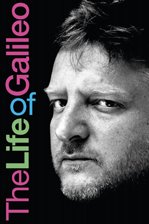
The play that I was impossibly trying to catch was The Life of Galileo, a play about which I knew nothing and had no expectations whatsoever. It was also part of the £10 sponsored season at the National, which was why I was fairly sanguine. If I missed the play completely, a stroll on the South Bank was an acceptable substitute; and I have, after all, lost more than £10 on poorly-judged purchases at a music store. But oh, what a waste it would have been if I had turned around and not walked the few extra steps to where an unexpectedly nice usher took pity on me and said he would sneak me in during a scene change in about three or four minutes. In all I missed about twelve minutes of a play that ran for three hours and ten minutes. And I'm actually considering going back to see all 190 minutes of it all over again, because every second of it was absolutely brilliant.

The costumes and sets were a melange of anachronisms, but the effect of this was to draw attention away from them, rather than toward: a kind of anti-operatic effect, to remove all sense of pageantry and period and focus attention on the text. Galileo's daughter, in flats and capris, could have strolled in off Oxford Street; on the revolve (the play is on the vast, well-equipped Olivier stage) she literally runs up against the cardinals in their medieval red and black. And in the middle of all this is Galileo himself, in a rumpled white linen shirt; he is not straddling these two worlds: he is what at the same time holds them together and yet, because he cannot help but do so, divides them by his words, ideas, and, not incidentally, his character. There are wonderful reviews of the play out there that I will not try to outdo, but I have to say that the two things the average educated person knows about Galileo were delivered brilliantly: the recantation, delivered offstage, with a time-shifted Simon Russell Beale sitting facing the audience, the map of the world on his face; and the coda 'e pur si muove' delivered in the final moments of the play visually, the very familiarity of the image delivering unto us, the audience, the universe as we know it.

It's a phrase that I have come to mutter, more in desperate hope than anything else, when the Oxford Tube is jammed on the ring road heading westward out of London.

Friday

Nice hair and no neuroses


Two of my favourite shows are wrapping up their final seasons (also known as being cancelled, an inhumanely casual sort of euphemism for ending the life of a series): Alias and The West Wing. Neither of them has appeared in DVD box set form yet, at least in the UK, but they are of course widely available on the Bitorrent underground network, and those of my friends who traffic in this sort of activity have given me mixed reviews of how each is brought to a close. I'll decide when the time comes whether I really want to see a pregnant Jennifer Garner (whose outfits have become less and less wearable since Season 3, incidentally) knot up JJ Abrams's promised 'ending with a bang'. The West Wing has been barely watchable for some time, despite a brief resurgence of intelligence in Season 5, but this will be more a valedictory parting of ways than anything else; I'd like to hang out with everyone for a final few hours, no matter how inane the script: one feels as though we have been through much together. But perhaps my lack of initiative to watch the final episodes are part of my inherent dislike of finishing anything: even with books I love, I have a tendency to stop just a few chapters shy of the end. The psychoanalysis involved isn't difficult: I have a natural fear of finishing anything, especially anything of my own; for after completion comes evaluation and, inevitably, judgement.

What I have been doing is starting on new series, and tonight I brought myself up to speed with the latest episodes of Doctor Who that aired while I was out of the country, and then found myself strangely absorbed with a workplace drama (never been my cup of tea) called Grey's Anatomy. It had all the elements of something I'd hate: for starters, an annoyingly pretty main character with great clothes, a tepidly good-looking love interest devoid of personality, with each episode built around a 'theme' about which Meredith Grey, the blonde surgeon whose makeup remains impeccable after a forty-eight hour shift, spouts predictable aphorisms. But it was recommended to me by someone whose taste has never led me wrong thus far, and indeed, I found myself shelving my past traumas of the genre from the likes of Ally McBeal and enjoying a sexy, well put together workplace drama. It's been almost a year since I left the workplace to get my second degree, and I suddenly remembered what a good day at work felt like: the feeling of doing something important and the satisfaction of a day's accomplishment; the pride of knowing that you're good at what you do; the subtle undercurrents of romance that spice up a day at the office.

The other rave I have about the series is the excellent music selection. I've always felt it was cheating, somehow, to get one's musical clues from television, rather than hanging out in smoky clubs to catch the newest band on the block; but life is short, I'm getting old, and I no longer read Vogue from cover to cover, nor do I grab the latest Guide Rouge and Gault-Millau hot off the press the way I used to. It caught my attention because I had been listening to Laura Michelle Kelly's 'Somewhere Only We Know' from her excellent The Storm Inside. It was another artist's version that was used, with excellent emotional timing, in the show, and I began to pay attention to the music; the highlight of Season One has to be Butterfly Boucher's 'Never Leave Your Heart Alone'.

But the final episode and predictable cliffhanger of Season One reminded me of the worst of the genre: an impassioned speech of pushbutton emotionalism, poorly written and badly delivered: it was like something out of Friends. Thank god that magnetic tape is not dead and that I have a friend who knows how to use his VCR (well, it's actually DVCPRO and it's his job), but thanks to him I can get up to date with the latest season of Spooks. I'm looking forward to some suitably depressing BBC fare until the next season of Grey's Anatomy comes out, with, no doubt, echoes of the spring collections in the copies of Marie Claire that I never actually had time to go through.

Thursday

Sound on wires


A friend and I had a nice, long Skype conversation the other day. It was also deep, meaningful, and emotional, but that's not germane to this post. The amazing fact of being able to have a phone-like conversation, across multiple time zones (or not: she could have been in the next room but pretending that she was in Kansas; or it could have been a metaphor) is still something that continues to amaze me. My previous experiences with Skype had not been auspicious; trying to use Skype on a laptop without a headset is a recipe for a disastrous conversation. Or three or four disastrous conversations, because you'll hear everything several times over.

This time, though, I was ready. I had a Shure large-diaphragm condenser microphone connected by a phase-inverting cable (aka XLR) to a mixer with a noise-reduction plug-in, in-ear monitors, and port forwarding. The only problem with this is that you're not quite sure whether to have a conversation or wait for the rest of the band to show up. Seriously, it feels very odd not to be clutching a handset. My senior tutor at Oxford has just gotten the hang of not holding the transducer to his ear and shouting into the telephone; he should get the hang of Skype in another thirty years' time. Meanwhile, conversations take on a certain performance aspect by the simple fact that one is one is standing before a microphone and pop-screen, and so, despite the fact that Skype is free, you feel the need to say something of Great Importance. Our next project is to attempt a three-way conversation with one of our male friends, who is generally into three-ways as a matter of course.

The other strange thing I've had to content with recently is paranoia that my phone is spying on me. 3G has many benefits; positive ones include the ability to check Gmail on the fly, but being able to locate you to tell you where the nearest cinema is can be somewhat disconcerting, and I'm sure can equally well be used to locate me for purposes other than to sell me Odeon tickets. It usually ticks away in silent mode (the official reason is that I find the ringing of a mobile phone intrusive, but I suspect it's actually a subconscious fear of unpopularity and I don't like to hear the absence of people calling me). Once in a while, though, it will suddenly flash into life for no discernible reason. Has someone hacked it and taken a picture of me typing away in my knickers? I've taken to wrapping it in swaddling cloth and burying it under the weight of the Complete Works of Byron. For someone who spends so much time with microphones and imaging gadgetry, being at home means being unseen and unheard, and the freedom, should I wish to do such a thing (but not that I would do such a thing, really) to stride naked across the room singing hit songs from the '90s.

Saturday

Better than a digital dowload


If there are two factors that can be said to have instigated the renaissance of my love affair with classical music, it is the radio and the phonograph: that is to say, my discovery of radio and the phonograph. One of the first things I did after moving into my dormitory quarters was to invest in a little clock radio; given that I have a problem controlling my irrepressible urge not to do things the normal way, it was inevitable that my little clock radio would be a DAB (Digital Audio Broadcasting) made by Tivoli Audio, known for those little, mono radios designed by the founder of Ruark in his dotage. I learned that you could connect a second speaker, a subwoofer, and even a CD player, and I brought home the little clock radio with one speaker with the vague idea that I would invest in the rest of the system later. I never did, partly because I eventually got a valve amplifier and standmount speakers, but mainly because it sounded so good on its own.

DAB was the next logical evolution for radio after FM. The difference between frequency modulation and amplitude modulation (known in the UK as medium wave), is a fundamental change in the way the signal is encoded: the metaphor usually used is that of a light blinking on a hilltop transmitting information; with MW (and shortwave, and most other forms of radio) the information is sent by the light flickering on and off. With FM, you have different colors of light, and the information is contained in the difference between the colors. DAB is though someone had put up a large neon billboard on the hilltop. Those who understand computers might prefer to think of it as a broadcast form of streaming audio (usually at somewhere between 160 to 192 kbps). It isn't absolutely perfect; there are times when the error rate goes up to the point that the signal deteriorates and I find myself switching over to FM (imagine a foggy night when you can't make out the billboard, but can still see the colored flashes of light). But in general the broadcast quality is impeccable, and you have to hand it to the BBC when it comes to sound engineering (and content).

Even better than BBC 3, though, is the UK's main classical music station, Classic FM. Their hegemony is so strong that they have their own record label, cable television channel, and music magazine as well. The programming, however, is top-notch, especially when you consider that this is a commercial radio station and not a state-sponsored one; classical music radio is not generally an easy sell in the contemporary world. Classic FM does (it would appear from the commercials) have a certain leaning in its listening demographic common to most classical music stations, and so one has to sit through contant ads related to erectile dysfunction, inheritance tax lawyers, and the like. But they are careful to make sure that they get a wide variety of phone-ins and emails, and in fact tend to bias those who aren't rich old men in carpet slippers looking out over their estate, favoring instead children, students, and the working class (either that, or these are the people who bother phoning in). There is a conscious aversion to 'greatest hits' and canonical performers; or you get one and not the other. Every so often they throw in something unexpected, like a movie theme, and on weekend evenings they play chill-out music under the rubric of a show called the Chiller Cabinet.

Even though I can now legally watch television, I only bother to tune in on Saturday evenings for you-know-Who. But the radio is a constant companion; it's so addictive that it has tended to get in the way of revision for examinations. 'Revision' is the British term for what I know as 'reviewing'; both are etymologically parallel in meaning 'to see again', my experience of revision is closer to the way I usually understand the word, as meaning a change or adjustment, i.e., 'so that's that the professor was talking about during the lecture that I hadn't read up for'. Come exam season the call-ins include lots of students asking for some Shostakovich to keep them company while revising. 'Good luck with your examinations, and here is the Fifth Symphony!' I myself am incapable of multitasking: this is a legacy of my age, I think; I grew up when 64MB of RAM was a lot, and I am incapable of having multiple applications running simultaneously, and the same is true of my brain. Kids these days, who can send text messages while surfing the net and having sex all at once, genuinely baffle me. Oh no, wait, that was me just a couple of years ago.

The use of the phonograph in this day and age as a source input seemed to be the domain of fussy old geezers obsessively balancing their tonearms; this is a misconception. It's the domain of fussy old geezers and me. As I mentioned in a previous post, there are some types of music that the phonograph does reproduce better than digital sources, and it's worth getting new pressings of some of this stuff. But for the most part I'm luxuriating in the wealth of cheap material out there, especially for classical music. There's a church down the road where you can pick through records in a bin and then drop a few coins into a collection box. (Oxford seems to be in the process of dumping its vinyl wholesale, and I'm only too happy to cart them back to my room.) Second-hand vinyl shops, meanwhile, need a strong tolerance for dust, a lot of spare time, and the patience to deal with snarky shopkeepers (these shops seem invariably to be manned by someone who will look over your selections with raised eyebrows and a sneer). Then you have to clean them; isopropyl alcohol is what I would normally use, but in Oxford you will find yourself directed down the road to the pub, which sells the only alcohol they are familiar with in these parts. I am debating whether to wipe down my vinyl with Guinness, or resort to something like lighter fluid.

But lo! Attention sneering shopkeepers everywhere, hearken to what I have found at the bins lately: Ashkenazy playing Beethoven's Appassionata; Horowitz performing at the Royal Albert Hall; Dvorak's cello concertos; Rachmaninoff performing his own Third Piano Concerto; and, for some reason, er, Susanne Vega. Oh, sorry, you can't listen to them, because I've got them now and you don't. Played though valves, they sound simply wonderful, and far too good to interrupt for revision.

The best clock radio in the world
Classic FM